

TL;DR:
- Most Bali dive sites are only accessible by boat, offering access to wrecks and remote reefs.
- Safety protocols, crew support, and proper briefing are key components of a secure boat diving experience.
- Bali boat diving is ideal for accessing iconic sites, but shore diving offers flexibility and lower cost.
Most travellers picture their first Bali dive as a slow wade from a sandy beach into calm shallows. In reality, the majority of Bali’s most celebrated sites, including the famous USAT Liberty wreck in Tulamben and the drift reefs off Nusa Penida, are only reachable by boat. Boat diving is not just a logistical detail; it is the key that unlocks Bali’s underwater world at its most spectacular. Whether you are a complete beginner curious about your first bubbles or a certified diver chasing new adventures, understanding how boat diving works will help you get more from every minute you spend below the surface.
Key Takeaways
| Point | Details |
|---|---|
| Boat diving basics | Boat diving gives access to Bali’s best underwater sites and unique safety practices. |
| Safety protocols matter | Following boat briefings and using DSMBs keeps divers visible and safe throughout a trip. |
| Preparation is key | Knowing what to pack and how to act on board ensures your first boat dive goes smoothly. |
| Training offers confidence | A specialty course or briefing helps even beginners dive boats safely and enjoyably. |
What is boat diving and how does it work?
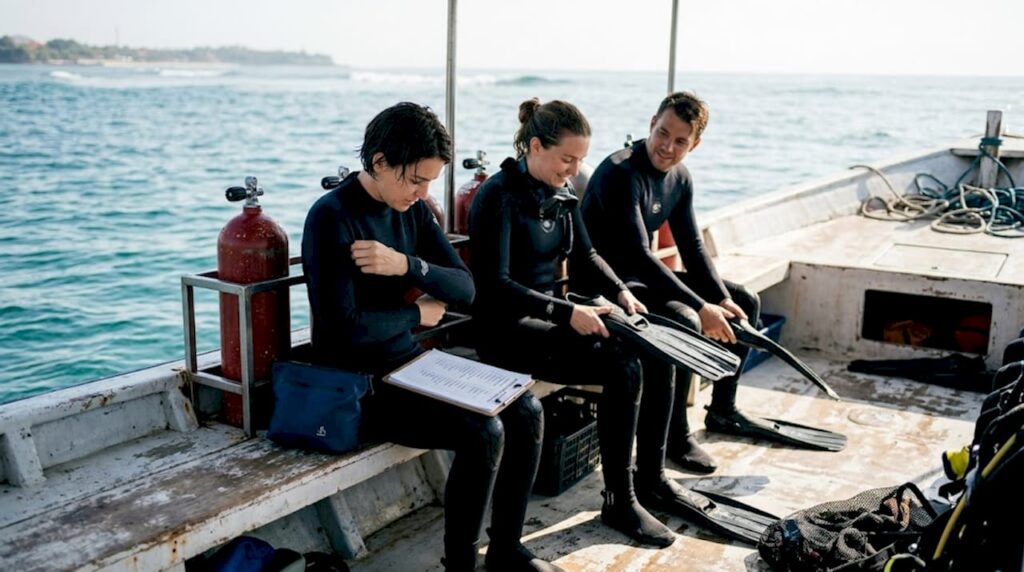
Boat diving simply means you travel by vessel to a dive site rather than entering from the shoreline. It sounds straightforward, but there is a whole set of procedures, skills, and etiquette that make it a distinct experience from shore diving.
With shore diving, you kit up on the beach, walk into the water, and descend at your own pace. You have complete independence but limited range. Boat diving gives you access to remote reefs, deep walls, and famous wrecks that would be exhausting or impossible to reach by swimming. The trade-off is that you work within a team structure, follow crew instructions, and manage your gear in a more compact space.
A typical boat dive follows this rhythm:
- Pre-dive briefing: The divemaster covers the site, hazards, currents, depth limits, and hand signals.
- Gear setup: Tanks and BCDs are assembled on the boat; space is shared, so organisation matters.
- Entry: Most Bali dive boats use the giant stride (stepping off the side) or back roll (rolling backwards off the gunwale) depending on boat height and conditions.
- The dive: You follow the guide, staying within the group while enjoying the site.
- Ascent and surface: You perform a safety stop at five metres, then use a DSMB to signal your position to the boat crew before surfacing.
- Exit: The crew helps you back aboard; fins come off first to make climbing easier.
“Boat diving is where preparation meets possibility. The crew, the briefing, and the protocols exist so you can focus entirely on what lies beneath.”
The comfort factor matters too. On a guided Bali dive package, tanks are handled, surface intervals are spent resting on deck, and experienced crew manage logistics. Compare that with shore diving, where you carry your own kit across rocks or sand. For many divers, especially first-timers, the supported structure of a boat dive actually reduces stress rather than adding to it.
| Feature | Boat diving | Shore diving |
|---|---|---|
| Site access | Remote reefs, wrecks | Nearshore only |
| Gear handling | Crew assisted | Self-managed |
| Entry method | Giant stride, back roll | Walk-in or giant stride |
| Group structure | Guided, team-based | Solo or buddy pair |
| Cost | Higher | Lower |
| Skill requirement | Basic to advanced | Basic |
If you are still building confidence in the water, our Bali dive courses include boat diving as a natural part of your learning journey.
Essential safety protocols and what to expect onboard
Boat diving introduces a specific set of safety considerations that shore diving does not. Understanding these before you step aboard makes the whole experience smoother and safer.
Every reputable dive operator in Bali will run a thorough safety briefing before departure. This covers emergency exits, lifejacket locations, fire extinguisher positions, and what to do if someone goes overboard. It might feel like a lot of information at once, but it only takes a few trips before it becomes second nature.
Here are the core safety principles you will encounter on any good boat dive:
- One hand for the ship, one for yourself. On a moving vessel, always maintain a grip on a rail or fixed point. Falls on deck are the most common boat-related injuries.
- Briefing is mandatory. Never skip the pre-dive briefing, even if you have dived the site before. Conditions change daily.
- DSMB for every ascent. A Delayed Surface Marker Buoy alerts the crew to your position. In busy waters or with live-boat pickups, this is critical for your safety.
- Regulator in until onboard. During live-boat pickups, keep your regulator in your mouth until you are safely back on the boat, not just at the surface.
- Signal clearly. If something goes wrong underwater, use standardised hand signals immediately. Do not wait until you surface to report a problem.
Pro Tip: Before your first boat dive, practise deploying a DSMB in a pool or calm shallow water. It is a small skill that makes a significant difference when you need it in open water.
Crew training is a genuine safety asset. Recent data shows 20 liveaboard incidents between 2022 and 2024, including fires and groundings, yet the majority resulted in no casualties, which reflects how well-trained crews can manage emergencies. Day-trip boats in Bali are generally lower-risk environments, but the principle holds: a skilled, attentive crew is your most valuable safety resource.
| Risk factor | Boat diving | Shore diving |
|---|---|---|
| Crew support in emergency | High | None |
| Risk of boat-related injury | Low with protocols | Not applicable |
| Open water currents | Managed by guide | Self-managed |
| Rescue response time | Fast, crew onsite | Depends on location |
Familiarising yourself with dive etiquette in Bali goes hand in hand with safety; knowing how to behave onboard and underwater protects everyone in the group.
Preparing for your first boat dive in Bali
Knowing what to expect on the day removes most of the pre-dive anxiety. Bali boat dives are generally well-organised, but a little preparation on your side makes the whole experience more enjoyable.
What to bring:
- Swimwear and a light rash guard or wetsuit
- Sunscreen (reef-safe only, please)
- Seasickness tablets taken at least 30 minutes before boarding
- Snacks and water for surface intervals
- Your dive certification card and logbook
- Cash for any extras (marine park fees, equipment hire)
- A small dry bag for valuables
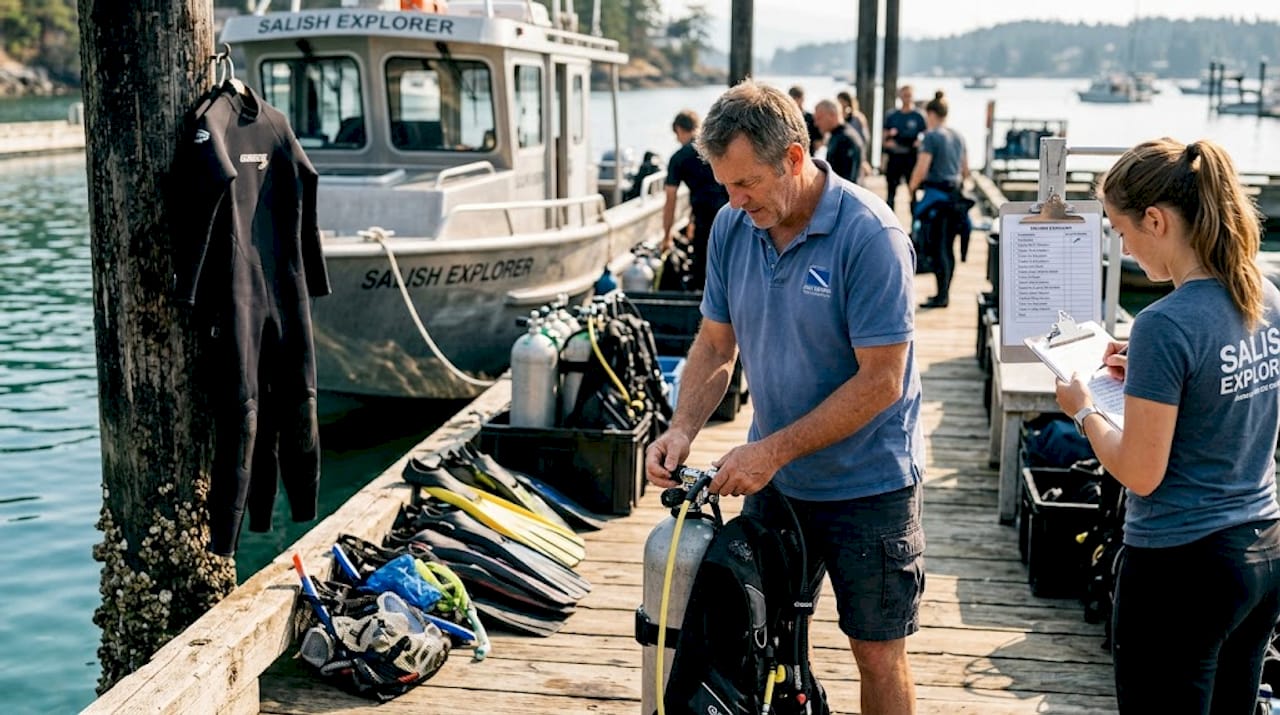
The day typically begins at the dock, where your gear is assembled and checked by the crew. You will receive a full site briefing covering depth, duration, current direction, and any marine life to look out for. Then it is a short boat ride to the site, which in Amed can be just a few minutes.
Entry methods such as the giant stride and back roll are both practised during your certification training, so they should already feel familiar. If they do not, tell your guide beforehand. A quick refresher on the boat takes about two minutes and makes entry far more confident.
Seasickness is a genuine concern for some divers. The best approach is preventative: take medication before you feel unwell, keep your eyes on the horizon, stay hydrated, and eat a light meal beforehand. Diving on an empty stomach or a very full one both increase the chances of nausea.
Pro Tip: Sit at the back of the boat near the waterline during the journey. It is where you feel the least motion, and it keeps you close to your gear for a quicker setup.
Onboard behaviour also matters. Respect the crew’s instructions, keep gear tidy and out of walkways, and avoid sitting on tank valves or other divers’ BCDs. Good dive site etiquette begins before you even enter the water. If you are working towards certification, our certification courses cover all of this in a relaxed, structured setting.
Is boat diving right for you? Comparing boat vs shore diving
Boat diving is genuinely exciting, but it is worth being honest about when it is the better choice and when shore diving might suit you just as well.
In Bali, the case for boat diving is particularly strong. Sites like the USAT Liberty wreck, the coral gardens of Jemeluk, and the pelagic-rich waters of Nusa Penida are simply not reachable from shore. If these are on your list, a boat is non-negotiable.
| Factor | Boat diving | Shore diving |
|---|---|---|
| Access to iconic Bali sites | Essential | Very limited |
| Marine life variety | High | Moderate |
| Cost per dive | Higher | Lower |
| Flexibility | Fixed departure times | Dive when you like |
| Ideal for beginners | Yes, with crew support | Yes, with buddy |
| Group experience | Team-oriented | Independent |
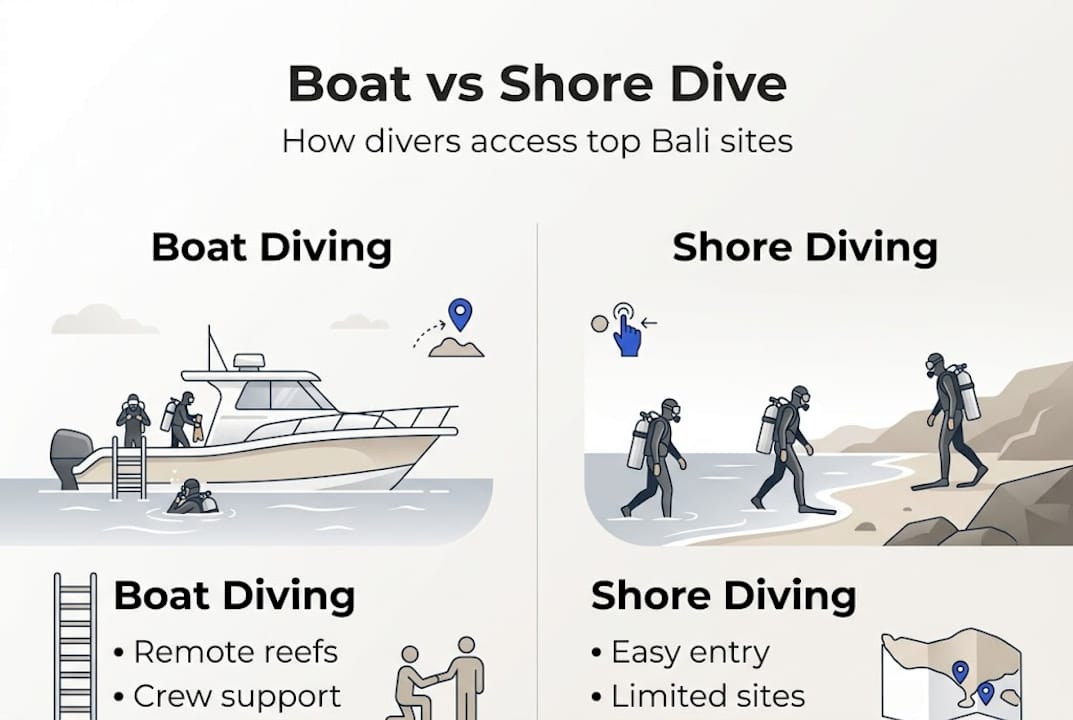
That said, shore diving has its strengths. It offers flexibility, lower cost, and a more independent experience. For macro enthusiasts, Amed’s shoreline is a treasure trove of nudibranchs, pipefish, and ghost pipefish that reward a slow, patient approach without any boat logistics involved.
The honest view, as noted in expert comparisons of boat versus shore diving, is that boat diving offers greater crew and gear support but demands stronger situational awareness in emergencies. Shore diving gives you independence but removes the safety net of an onboard crew.
“Choose boat diving when the destination demands it. Choose shore diving when you want to slow down and explore at your own rhythm.”
For divers who want to feel genuinely confident in both environments, the PADI Advanced Open Water course is an excellent step. It builds the skills to handle varied conditions, currents, and deeper sites that boat diving typically involves. You might also consider PADI specialty courses such as the Boat Diver or Drift Diver specialties, which are tailor-made for exactly this kind of diving.
Why Bali boat diving holds more than meets the eye
There is a persistent idea that boat diving is more dangerous or more complicated than shore diving, and that idea puts some travellers off before they have even tried it. We disagree, and sixteen years of experience in Amed’s waters backs that up.
The truth is that general scuba risks remain low with proper training, and while liveaboard incidents have been rising post-COVID with 75% resulting in no casualties, day-trip boat diving in a place like Amed is a fundamentally different and more controlled environment. What actually reduces risk is not avoiding boats but building your skills and diving with experienced, attentive crews.
Bali’s local dive crews carry something that no amount of online research can replicate: genuine, site-specific knowledge built over years of daily dives. They know where the current shifts at Jemeluk Bay, which corner of the Liberty wreck schools of fish favour in the morning, and how to read the conditions before you even gear up. That knowledge is an enormous part of what you are paying for.
Familiarising yourself with Bali dive site etiquette before you go adds another layer of confidence. Boat diving, especially in Bali, is an invitation to experience the island’s underwater richness in a way that shore diving simply cannot match. Embracing it, rather than avoiding it, is where the real adventure begins.
Ready to dive in? Explore Bali’s best boat diving experiences
If this guide has sparked your curiosity, we would love to help you take the next step. At Bali Dive Cove, our boat diving courses are designed to build your confidence from the very first briefing, whether you are a nervous first-timer or a certified diver looking to sharpen your skills.
Our Bali boat dive packages give you access to Amed’s most spectacular sites, from the Liberty wreck to vibrant coral gardens, all guided by instructors with over 16 years of local experience. Small groups, unhurried dives, and genuine care for your safety are what we do. Browse our Bali dive sites to see what awaits you beneath the surface, and get in touch when you are ready to plan your trip.
Frequently asked questions
Do I need special training to go boat diving in Bali?
No formal qualification is required for a guided boat dive, but the PADI Boat Diver specialty is highly recommended for beginners as it covers seasickness management, etiquette, and line use, with your first dive counting towards Advanced Open Water certification.
Is boat diving safe compared to shore diving?
Boat diving in Bali is very safe when conducted with a trained crew and proper protocols. While 20 liveaboard incidents occurred between 2022 and 2024 globally, the vast majority resulted in no casualties, and day-trip boat diving carries a lower risk profile still.
What equipment do I need for my first boat dive?
Standard scuba gear covers the basics, but you will also need a DSMB for safe ascents to signal your position to the boat crew. Your dive centre will advise on any additional items specific to the site.
How do I avoid seasickness on a Bali boat dive?
Take seasickness remedies before boarding and pair them with staying hydrated, eating lightly beforehand, and sitting near the waterline at the back of the boat for minimal motion.
