

TL;DR:
- Coral reefs are alive, built from tiny colonial animals called polyps secreting calcium carbonate skeletons.
- Reef health depends on partnerships with microscopic algae called zooxanthellae that provide most of their energy.
- Protecting reefs relies on responsible diving, reducing global climate impacts, and supporting restoration efforts.
Most people arriving in Bali picture coral reefs as colourful underwater gardens, full of waving plants and decorative rock formations. In reality, those vibrant structures are living animal colonies, built grain by grain over centuries by creatures no larger than a grain of rice. Understanding what reefs actually are, how they function, and what threatens them transforms a pleasant snorkel or dive into something far more meaningful. Whether you are planning your first open-water experience in Amed or you are a seasoned diver returning to East Bali’s famous walls and slopes, knowing the science behind what you are looking at makes every moment underwater richer, more responsible, and far more rewarding.
Key Takeaways
| Point | Details |
|---|---|
| Reefs are living animals | Corals are animals creating complex colonies, not plants or rocks. |
| Algae power reef survival | Most corals depend on a partnership with algae, which provides their energy and colour. |
| Bleaching is a warning sign | White corals have lost their algae but are not always dead—recovery depends on quick stress reduction. |
| Divers have real impact | Simple, mindful actions underwater help reduce risks and protect reef health for the future. |
| Local and global action matter | Both hands-on restoration and advocacy for climate solutions are crucial to keep reefs thriving. |
What coral reefs are made of
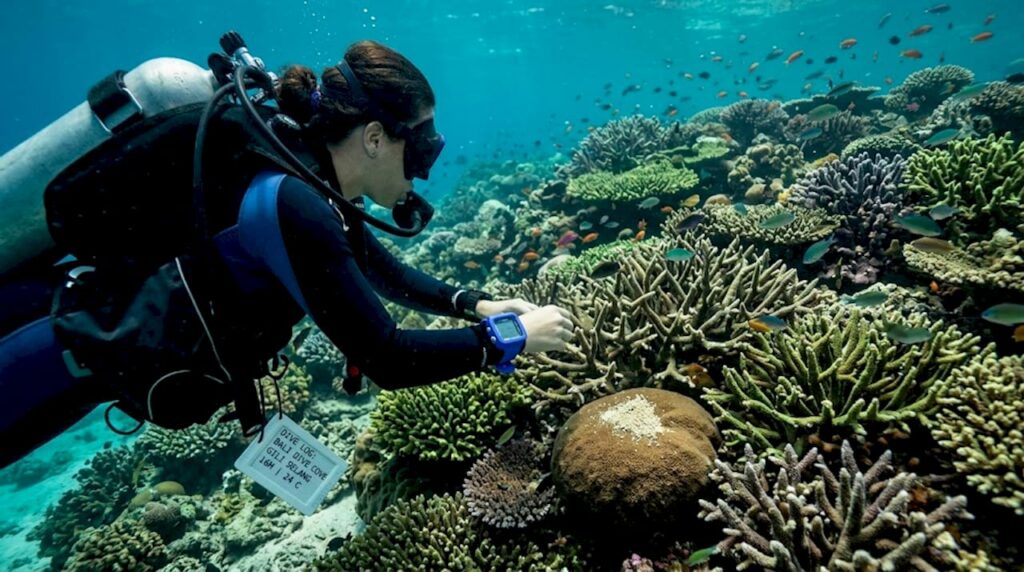
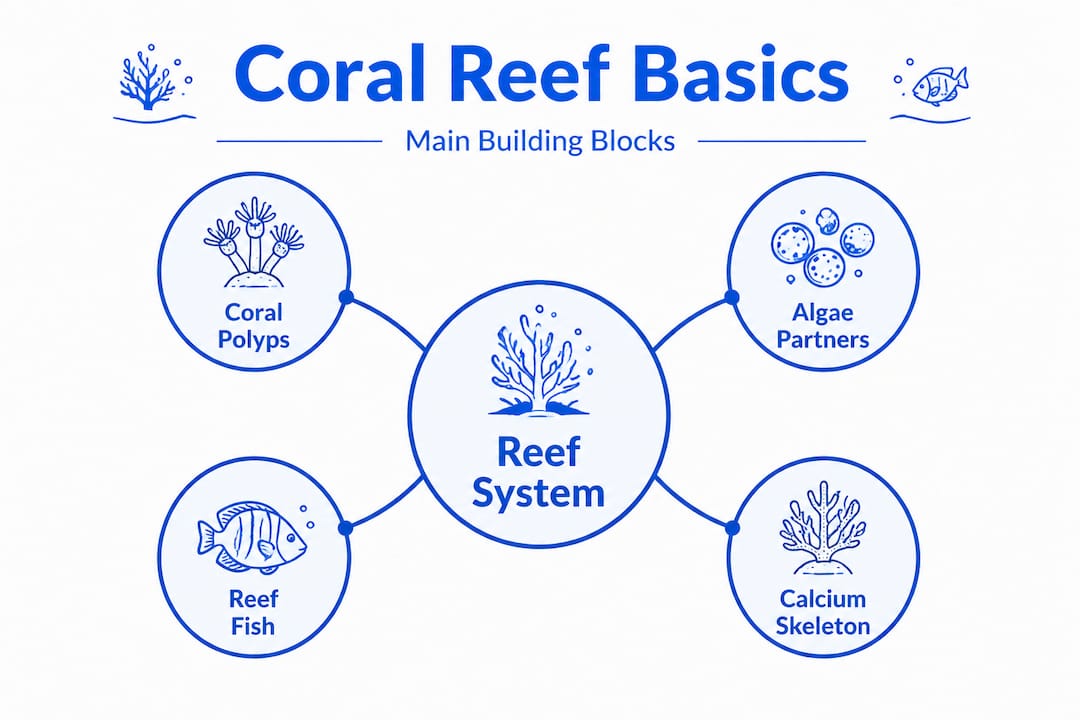
The single biggest misconception about coral reefs is that they are geological features, like underwater cliffs or rock gardens. They are not. Reef-building corals are colonial animals that grow by secreting calcium carbonate skeletons over time, stacking generation upon generation of hard material into the complex structures we see today. Each tiny individual animal is called a polyp, and a single coral head can contain thousands of them, all genetically identical and working together as one organism.
The living part of any reef is surprisingly thin. Just a few millimetres of tissue coat the surface of what is, beneath it, centuries of compacted skeleton. Think of it like the bark on an ancient tree: vibrant and alive on the outside, but supported by a much older, denser core. That thin living layer is where all the action happens: feeding, reproducing, growing, and forming the partnerships that keep the whole system running.
Key facts about reef structure:
- Coral polyps are soft-bodied animals related to jellyfish and sea anemones
- Each polyp builds a hard cup of calcium carbonate around itself for protection
- Reef growth is slow, typically between 0.3 and 10 centimetres per year depending on species
- A single reef system can take thousands of years to reach its current size
- The Great Barrier Reef, the world’s largest, began forming roughly 20,000 years ago
| Reef component | What it is | Role in the ecosystem |
|---|---|---|
| Coral polyp | Living animal | Builds skeleton, feeds, reproduces |
| Calcium carbonate skeleton | Hard mineral structure | Physical foundation of the reef |
| Crustose coralline algae | Encrusting red algae | Cements reef fragments together |
| Rubble zones | Broken skeleton fragments | Habitat for juvenile fish and invertebrates |
As a diver, knowing this helps you understand why responsible reef behaviour matters so much. Brushing a fin against a coral head does not just scratch a rock. It damages living tissue that may have taken decades to grow.
Pro Tip: When hovering near a reef, focus on your buoyancy rather than your surroundings. A controlled, neutral hover keeps you from accidentally contacting coral, and it also makes you a much better diver overall.
Now that we understand reefs are alive, let us explore how they function beneath the surface.
The living partnerships: Corals and their allies
Having explored reef structure, let us illuminate the teamwork that keeps them alive. Reefs do not thrive on coral alone. The entire system depends on a remarkable partnership between corals and microscopic algae called zooxanthellae (pronounced zo-zan-THEL-ee). These algae live inside coral tissues and are responsible for giving most shallow-water reefs their extraordinary range of colours, from golden yellows and burnt oranges to electric blues and deep purples.
More critically, zooxanthellae provide over 90% of a coral’s energy through photosynthesis, converting sunlight into sugars that feed the polyp. In return, the coral provides the algae with shelter and the nutrients they need to photosynthesise. It is a mutually beneficial arrangement that has powered coral reef ecosystems for millions of years.
“Without their zooxanthellae, shallow-water corals would be unable to build reefs at the pace needed to keep up with sea-level changes or recover from damage. The algae are not passengers; they are the engine.” — Marine biologists frequently use this framing to explain why light and water clarity are non-negotiable for reef health.
Not all corals follow this model. Deeper-water corals, which receive little or no sunlight, rely entirely on capturing plankton and organic particles from the water column. These azooxanthellate corals tend to grow even more slowly and are far less studied, but they form their own remarkable ecosystems in cold, dark water far below recreational dive limits.
What zooxanthellae loss looks like in practice:
- Stressed corals expel their algae, revealing the white calcium carbonate skeleton beneath
- This is coral bleaching, a warning signal rather than immediate death
- Bleached corals are weakened and highly vulnerable to disease
- Recovery is possible if water temperatures drop and stressors are removed quickly
- Prolonged bleaching, lasting weeks or months, typically leads to coral death
| Coral type | Energy source | Depth range | Colour |
|---|---|---|---|
| Zooxanthellate (shallow) | Algae photosynthesis + some feeding | 0 to 60 metres | Vivid, varied |
| Azooxanthellate (deep) | Plankton and particle feeding | 60 metres and below | White, orange, red |
If you are diving in Bali in 2026 and you spot patches of white coral surrounded by healthy colour, you are witnessing bleaching in real time. It is worth pausing to observe rather than touch, and to share what you saw with your dive guide afterwards. Understanding scuba diving basics before your first dive will also help you stay calm and observant in moments like these.
Reef types and formation: From fringing to atolls
With partners powering reefs’ survival, let us look at how these ecosystems evolve across the globe and in Bali. Not all reefs look the same, and the differences go far deeper than aesthetics. Reef formation follows distinct pathways linked to sea-level change and the geological movement of the land beneath them, producing three main reef types that divers encounter around the Indo-Pacific.
The three main reef types:
-
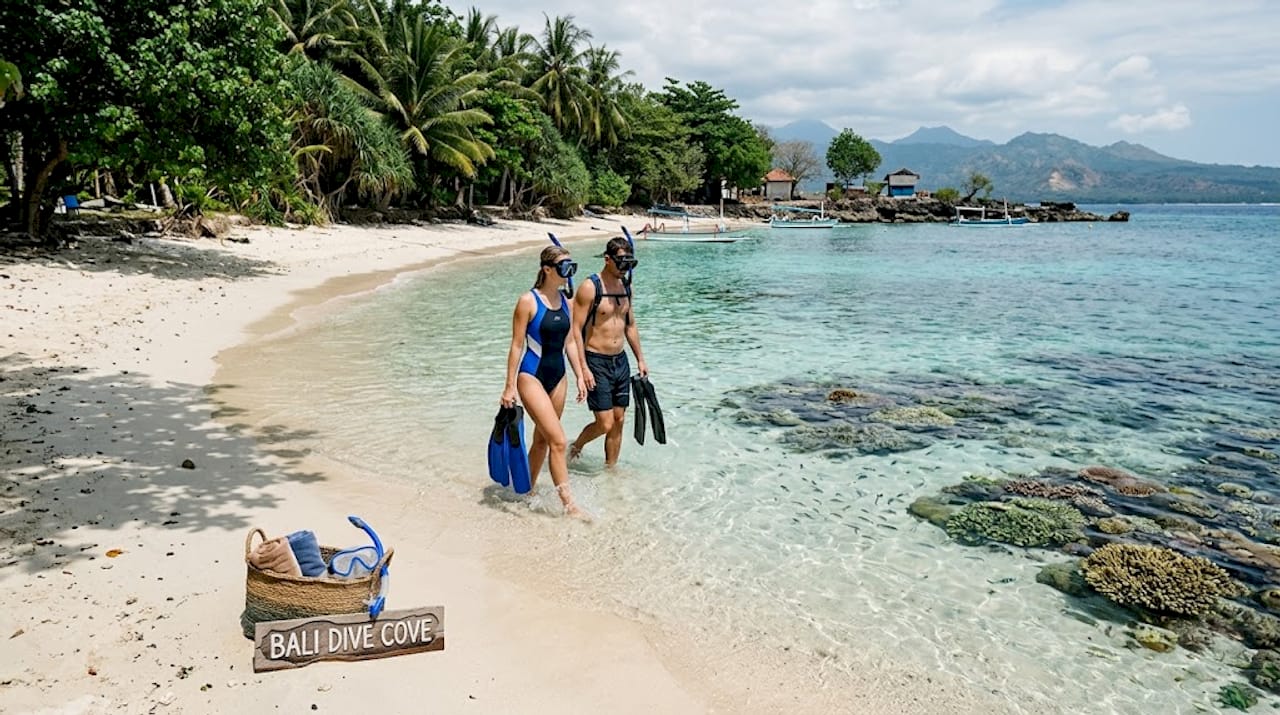
Fringing reefs grow directly from a shoreline, extending outward into the sea with little or no lagoon between reef and land. These are the most common reef type globally and the type you will encounter most frequently when exploring the types of diving in Bali. Amed’s reefs are classic fringing reefs, beginning just metres from the beach.
-
Barrier reefs are separated from the coastline by a wide, shallow lagoon. They form when land subsides slowly over geological time, allowing the reef to keep growing upward while the shoreline retreats. Australia’s Great Barrier Reef is the most famous example, stretching over 2,300 kilometres along the Queensland coast.
-
Atoll reefs are ring-shaped structures surrounding a central lagoon, typically marking the location of a volcanic island that has sunk beneath the sea. The Maldives and many Pacific island groups are classic atolls, offering some of the world’s most spectacular diving in their passes and outer walls.
| Reef type | Relationship to land | Lagoon present | Example location |
|---|---|---|---|
| Fringing | Adjacent to shoreline | No or very narrow | Amed, Bali |
| Barrier | Separated from shore | Yes, wide and shallow | Great Barrier Reef, Australia |
| Atoll | Encircles sunken volcano | Yes, central lagoon | Maldives, Micronesia |
Each reef type creates a different dive environment. Fringing reefs like those in Amed offer easy shore access, shallow entry points suitable for beginners, and rich macro life tucked into every crevice. Barrier reefs and atolls often feature stronger currents, bigger pelagic species, and dramatic wall dives. Knowing which type you are diving helps you set realistic expectations and prepare appropriately for the conditions you will meet.
Threats to coral reefs: What every diver should know
With a clear view of reef layouts, it is time to address the greatest challenges facing reefs you will visit. The news is not comfortable, but it is essential. Warming-driven bleaching and ocean acidification are the two most significant global threats to coral reefs, and they are accelerating. As ocean temperatures rise, bleaching events that once occurred every 25 to 30 years now happen every five to six years in many regions, leaving reefs insufficient time to recover between episodes.
Ocean acidification is a separate but related problem. As the ocean absorbs excess carbon dioxide from the atmosphere, it becomes more acidic, making it harder for corals to build and maintain their calcium carbonate skeletons. Think of it as the ocean slowly dissolving the very foundation reefs are built on.
“The largest coral bleaching event on record has impacted 84% of the world’s reefs, underscoring just how urgent the situation has become for reef ecosystems worldwide.”
Local stressors compound global threats significantly. Runoff carrying agricultural chemicals, sewage, and sediment smothers corals and blocks the sunlight that zooxanthellae need. Destructive fishing practices, unregulated coastal development, and poorly managed tourism all chip away at reef resilience, making reefs less able to withstand the global pressures they already face.
What divers can do to minimise their impact:
- Never touch, stand on, or collect coral, even if it appears dead
- Maintain excellent buoyancy at all times, especially near the reef
- Use only reef-safe sunscreen, or better yet, wear a rash vest for UV protection
- Avoid stirring up sediment with your fins, as it can smother coral polyps
- Rinse your equipment thoroughly to prevent transferring invasive species between sites
- Follow your pre-dive checklist to ensure your gear is correctly configured before entering the water
Pro Tip: Reef-safe sunscreen labels can be misleading. The safest option for corals is a mineral-based sunscreen containing only zinc oxide or titanium dioxide, applied at least 30 minutes before entering the water. Even better, cover up with a long-sleeved rash vest and skip the sunscreen altogether when diving.
Following practical dive conservation tips is one of the simplest ways to ensure that the reefs you visit today remain vibrant for the divers who come after you.
Conservation and restoration: How you can help
Now, let us focus on what can be done, both by you and the wider community, to secure the future of these remarkable ecosystems. Reef restoration has grown into a sophisticated field, moving well beyond simply placing rocks on the seabed. Modern restoration techniques include growing coral fragments in underwater nurseries, outplanting nursery-raised colonies onto degraded reefs, and even collecting coral eggs and sperm during spawning events to create new genetic combinations that may prove more resilient to warming.
These methods are genuinely exciting and they do make a difference, particularly on local scales. But it is important to be honest about their limitations. Restoration cannot keep pace with large-scale bleaching events driven by global temperature rise. It is a vital tool, but it works best when paired with serious action on climate change and local pollution reduction.
Four practical steps you can take as a travelling diver:
- Choose dive operators who actively support reef restoration in Bali and follow verified eco-friendly practices
- Participate in organised reef clean-up dives when they are available during your trip
- Avoid purchasing souvenirs made from coral, shells, or other marine organisms
- Share what you learn about reef health with friends and family at home, amplifying the message beyond the dive community
Statistic to remember: Coral reefs cover less than 1% of the ocean floor, yet they support an estimated 25% of all marine species. Losing them would be catastrophic for ocean biodiversity and for the hundreds of millions of people who depend on reefs for food, coastal protection, and income.
Pro Tip: Before booking any dive trip, ask your operator directly what conservation practices they follow. Questions like “Do you limit group sizes near the reef?” or “Do you participate in any restoration projects?” quickly reveal how seriously an operator takes their environmental responsibility.
Our perspective: Why reef basics matter for every traveller
Here is something we have noticed after years of guiding divers across Amed’s reefs: the most impactful thing most visitors can do is also the least glamorous. It is not planting a coral fragment or posting a conservation message online. It is simply learning to move through the water without disturbing anything, and genuinely understanding why that matters.
There is a tendency in eco-tourism to focus on visible acts of restoration, coral gardening photos, clean-up dives, reef pledge certificates, because they feel productive and they look good. We are not dismissing those efforts. They have real value. But they can sometimes create a false sense that the problem is being solved at the local level, when the deeper crisis is global and requires advocacy that extends far beyond the dive site.
The most honest thing we can tell you is this: your greatest contribution as a visiting diver is restraint. Touching nothing. Stirring nothing. Taking nothing. Leaving the reef exactly as you found it, or better. That, combined with supporting conservation perspectives and climate-conscious choices in your daily life at home, is where real stewardship lives.
Understanding reef biology, as this article has tried to lay out, is the foundation of that restraint. You cannot respect something you do not understand. Knowing that the colourful surface you are hovering above is a living community of animals, powered by microscopic algae, built over centuries, and currently under enormous pressure, changes how you move through the water. It changes what you notice, what you protect, and what stories you carry home.
Explore Bali reefs responsibly with Bali Dive Cove
Ready to practice what you have learned and see these reefs up close? At Bali Dive Cove, we believe that informed divers are the best divers, for the reef and for themselves. Based in Amed, East Bali, we have been guiding divers across some of Indonesia’s most beautiful fringing reefs since 2018, always in small groups, always at a pace that lets you truly absorb what you are seeing.
Whether you are ready to take your first underwater breaths through one of our dive courses in Bali or you are looking for guided reef and wreck experiences through our Bali dive packages, we are here to make your time underwater safe, rewarding, and genuinely respectful of the ecosystems we all love. Come and see Amed’s reefs the right way.
Frequently asked questions
Are coral reefs alive or dead stone?
Coral reefs are living animal colonies topped by a thin layer of living polyps, supported by older calcium carbonate skeleton underneath. The rock-like appearance is the accumulated skeleton of countless generations of coral animals.
What causes coral bleaching?
Bleaching happens when stressed corals expel their vital zooxanthellae algae partners, losing their colour and primary energy source. Heat, pollution, and sediment are the most common triggers.
Can corals recover after bleaching?
Yes, if stressful conditions improve quickly, some corals can regain their algae and recover. However, prolonged bleaching events lasting weeks or months typically cause permanent coral death.
What simple actions can divers take to protect coral reefs?
Avoid touching corals, use reef-safe sunscreen or a rash vest, maintain neutral buoyancy throughout your dive, and choose operators who actively support conservation and follow responsible reef practices.
How are coral reefs restored if damaged?
Restoration includes growing nursery-raised coral fragments and outplanting them onto degraded reefs, as well as collecting coral eggs and sperm to develop more resilient genetic varieties for future outplanting.
