


TL;DR:
- A dive profile records depth over time and is crucial for safety and nitrogen management.
- Different profile types include square, multi-level, and sawtooth, each with varying safety implications.
- Proper profile planning, monitoring, and understanding prevent decompression sickness and enhance dive experience.
Most divers heading to Bali think about two things: how deep they’re going and how long they’ll be underwater. It’s a natural starting point, but it only tells part of the story. Your dive profile, the full record of your depth over time, is what truly determines how safe, comfortable, and rewarding your dive will be. Whether you’re taking your first breaths underwater in Amed or dropping down to explore the famous USAT Liberty wreck in Tulamben, understanding your dive profile gives you a real edge. This guide breaks it all down clearly, for beginners and experienced divers alike.
Key Takeaways
| Point | Details |
|---|---|
| Dive profiles explained | A dive profile tracks your depth every minute to keep your underwater time safe and enjoyable. |
| Tools matter | Using computers and proper tables helps you map and stick to safe profiles, especially in Bali’s varied sites. |
| Safety is personal | Adapting your profile to your skills and conditions reduces risk and lets you get more from each dive. |
| Know common pitfalls | Avoid risky patterns like sawtooth profiles and always finish with the right safety stops. |
| Profile knowledge unlocks more | Better understanding turns a standard dive into a richer, safer Bali experience. |
What is a dive profile?
Think of a dive profile as your underwater journey mapped out on a graph. On one axis, you have depth. On the other, you have time. The line connecting them tells the complete story of your dive, from the moment you descend to the moment you surface. It’s not just a logging formality. It’s one of the most important safety tools in scuba diving.
A dive profile is the record of a diver’s depth over time, used to calculate decompression requirements and manage risks like decompression sickness (DCS). DCS, sometimes called “the bends,” happens when nitrogen absorbed under pressure forms bubbles in your body as you ascend too quickly or exceed safe exposure limits. Your dive profile is what determines whether that risk stays low or climbs dangerously.
A complete dive profile includes several key components:
- Entry depth and entry time: When you start descending and how quickly you reach your target depth.
- Maximum depth: The deepest point reached during the dive.
- Time at depth: How long you spend at each level, not just the deepest point.
- Ascent rate: How quickly you rise back to the surface, ideally no faster than 9 metres per minute.
- Safety stops: A pause at 5 metres for at least 3 minutes near the end of the dive to off-gas safely.
- Surface interval: The time spent on the surface between dives, which affects nitrogen loading on repeat dives.
In Bali, the variety of dive sites makes profile awareness especially important. A gentle reef slope in Amed, where you might spend most of your dive between 8 and 18 metres, produces a very different profile to a vertical wall dive where you can easily drift deeper than planned. Our dive packages in Bali are designed with these variations in mind, matching each dive to appropriate profiles for the conditions and skill level involved.
“A dive profile is far more than just a number on your computer. It’s the full story of your dive, and that story determines how safely your body processes nitrogen the whole way through.”
Many beginners assume that as long as they don’t go too deep and don’t stay too long, they’re safe. But two dives to 18 metres for 40 minutes each can carry very different risks depending on how those dives were conducted. If one included a rapid descent, an uncontrolled ascent, and no safety stop, the risks are significantly higher than a smooth, controlled dive to the same depth and duration. If you’re new to all of this, our beginner’s guide to scuba diving is a great place to build that foundational knowledge.
Key types of dive profiles and what they mean
Not all dive profiles look the same. The shape of your profile matters enormously, both for safety and for getting the most out of your dive. There are three main types you’ll encounter in recreational scuba diving.
Square wave profiles involve descending to a single depth quickly, staying there for most of the dive, and then ascending. They’re called “square” because of how they look on a graph. This is the most conservative profile and the one used in PADI training. PADI’s RDP tables assume square profiles for no-decompression limits, and beginner divers in the Open Water course learn at a maximum depth of 18 metres.
Multi-level profiles start deep and gradually move shallower as the dive progresses. You might begin at 25 metres on a reef slope, move up to 18 metres to explore a coral garden, and finish at 10 metres near the surface. This is the most common profile for experienced recreational divers and allows for longer bottom times because you’re spending time at shallower depths where nitrogen absorption is slower.
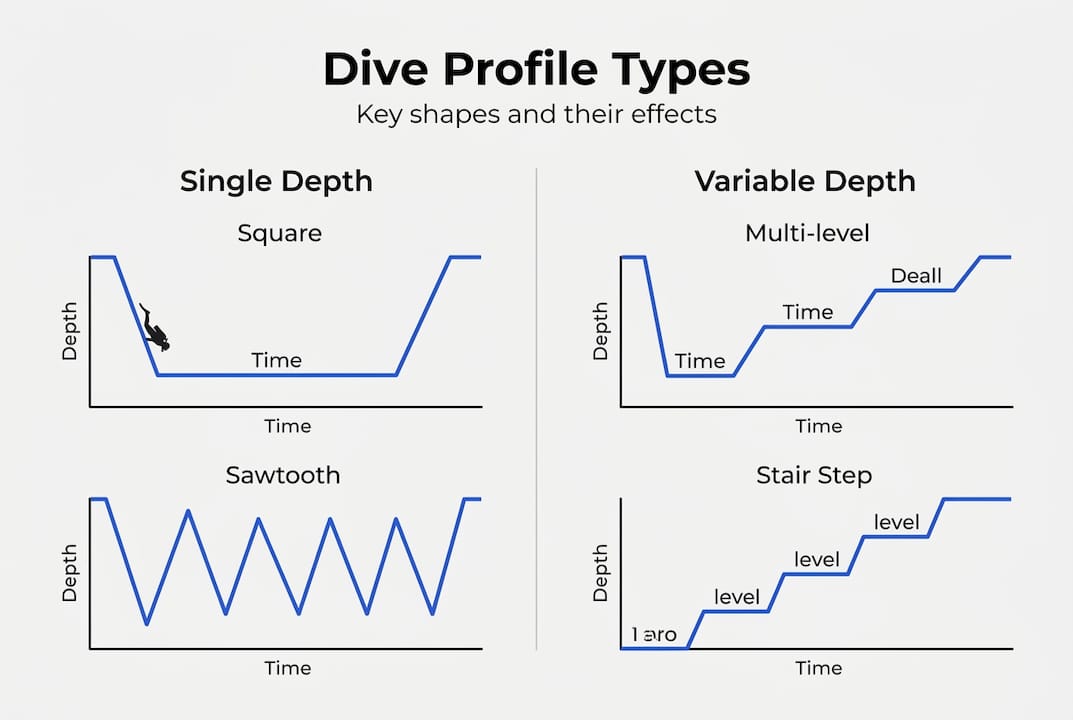
Sawtooth profiles involve repeated up-and-down movements during a dive. They’re common when divers have poor buoyancy control and yo-yo between depths. Sawtooth profiles increase decompression risk significantly and are best avoided, particularly for beginners still developing their buoyancy skills.
| Profile type | Typical Bali site | Risk level | Best suited for |
|---|---|---|---|
| Square wave | Training dives, shallow reefs | Low | Beginners, certification dives |
| Multi-level | Amed Wall, reef slopes | Low to moderate | Experienced recreational divers |
| Sawtooth | Anywhere with poor buoyancy | High | To be avoided |
Here’s what the profile choice means in practice for Bali diving:
- On muck diving sites like Amed’s sandy slopes, a gentle multi-level profile lets you search at varying depths without unnecessary nitrogen loading.
- On the USAT Liberty wreck, a square profile keeps things predictable and safe, especially for less experienced divers visiting for the first time.
- On wall dives, where it’s easy to drift deeper than intended, profile awareness is critical for managing your no-decompression limits (NDL).
Pro Tip: Choose your profile to match both your training level and the specific environment. Stick to square profiles for training dives and any site with unpredictable conditions. Use multi-level profiles on gradual reef slopes once you’re confident in your buoyancy. If you’re working on your PADI Open Water courses, your instructor will always guide you through the appropriate profile for each dive.
How dive computers and tables shape your profile
Once you understand the types of profiles, the next step is knowing how to track and manage them. This is where dive computers and planning tables become essential tools rather than optional extras.
Dive computers are the most common tool used by recreational divers today. They continuously monitor your depth using a pressure sensor and calculate your real-time decompression status using built-in algorithms. Dive computers track profiles using algorithms like Bühlmann ZH-L16, a perfusion-limited model that divides body tissue into parallel compartments with different nitrogen uptake rates. Another common model is DCIEM, which uses a diffusion-limited, serial compartment approach. Neither algorithm is perfect, which is why most computers allow you to adjust conservatism settings.
One important setting to understand is Gradient Factors (GF). These are used to dial in how conservative your computer’s decompression calculations are. A setting like GF 30/80 is commonly recommended for recreational diving, meaning the computer builds in a comfortable buffer before warning you about decompression obligations. The lower the first number, the earlier your computer starts calculating off-gassing. The higher the second number, the more nitrogen it allows before surfacing.
For beginners, the traditional approach uses PADI Recreational Dive Planner (RDP) tables alongside manual dive logs. Here’s how a basic planning process works:
- Choose your planned maximum depth for the dive.
- Look up the no-decompression limit (NDL) for that depth on the RDP table.
- Plan your bottom time to stay well within that limit.
- After the dive, calculate your pressure group and surface interval before planning the next dive.
- Log everything: depth, time, air used, and conditions.
For experienced divers, a dive computer handles all of this automatically and in real-time, which allows for flexible multi-level profiles that dramatically extend bottom time. For example, dropping to 25 metres and then gradually moving up to 12 metres as air decreases gives your computer the information it needs to recalculate your NDL on the fly, often giving you significantly more time underwater than a square profile table would allow.
Pro Tip: Always check your computer’s profile readout during the dive, not just at the end. Monitoring your ascent rate indicator, current NDL, and depth in real-time is one of the simplest habits that separates safe divers from careless ones. If you’re new to diving in Bali and want to get familiar with this as part of your scuba diving preparation workflow, our instructors will walk you through exactly how to read your computer before, during, and after every dive.
Dive profiles in practice: maximising safety and dive time in Bali
Now let’s bring everything together and look at how dive profiles work in the real world, specifically across Bali’s incredible range of dive sites.
At typical Bali depths of 18 to 30 metres, NDL can vary considerably depending on the algorithm, anywhere from 8 to 25 minutes for square profiles at around 30 metres. That’s a wide range, and it shows exactly why your choice of computer, profile type, and approach can make a meaningful difference to how much time you actually spend exploring the reef.
Here’s how informed profile planning plays out across some of Bali’s most loved sites:
- Amed Wall: A multi-level profile works beautifully here. Start your descent at around 25 metres to enjoy the deeper coral formations, then work gradually shallower as air reduces. You’ll extend your bottom time while naturally off-gassing as you ascend.
- USAT Liberty wreck, Tulamben: Most of the wreck is accessible between 5 and 30 metres. A square profile keeps things clean and predictable, and you’ll be rewarded with abundant marine life at all depths without needing to push limits.
- Muck diving in Amed: Shallower profiles of 10 to 15 metres are typical, giving you long, relaxed dives to spot nudibranchs, frogfish, and other tiny wonders in the sandy shallows.
Avoiding common profile mistakes is just as important as planning well. The most frequent errors we see include:
- Rapid ascents: Rising faster than 9 metres per minute significantly increases DCS risk. Always ascend slowly and let your computer guide the rate.
- Skipping safety stops: Even when your computer shows no decompression obligation, a 3-minute stop at 5 metres is a worthwhile habit on every dive.
- Sawtooth errors: Poor buoyancy control is the root cause of most sawtooth profiles. Practising buoyancy before diving unfamiliar sites pays off every time.
- Ignoring surface intervals: Nitrogen from your first dive stays in your body. Skipping a proper surface interval before a second dive means your NDL starts shorter than you might expect.
A simple safety checklist for every Bali dive:
- Plan: Know your max depth, NDL, and target profile type before you enter the water.
- Execute: Monitor your computer throughout, maintain a slow ascent, and always complete your safety stop.
- Review: Check your computer’s logged profile after the dive and note any moments where depth or rate exceeded your plan.
Our beginner dive tips cover many of these habits in more detail, and they’re worth revisiting whether you’re on your first dive or your fiftieth.
Why mastering your dive profile matters more than you think
After many years of guiding divers through Amed’s reefs, walls, and wrecks, we’ve noticed something that almost no training manual mentions directly. Most dive incidents don’t start with one dramatic mistake. They start with a series of small, easily overlooked profile errors that quietly stack up beneath the surface.
A diver ascends a little quickly here, skips the safety stop there, and makes a second dive with a shorter surface interval than planned. Individually, none of these feel significant. Together, they push nitrogen loading much closer to unsafe levels than any single number on a table would suggest.
Beginners understandably fixate on depth and air pressure. Both are visible, tangible, and easy to monitor. But profile control, managing your ascent rate, your time at each depth, and your surface intervals, is what separates divers who simply get wet from divers who stay safe dive after dive, year after year. Seasoned divers get more time underwater precisely because they use multi-level profiles and real-time computer data to manage nitrogen intelligently rather than conservatively guessing.
We’ve seen real-world dive insights from divers who arrived in Amed thinking profiles were an advanced topic they’d worry about later. After one guided dive where we walked through the computer readout together, they never looked at a dive the same way again. Profile awareness isn’t a dry technicality. It’s the thing that lets you stay longer, go more often, and come back safely every single time.
Plan your next safe, unforgettable dive with Bali Dive Cove
Understanding dive profiles is one thing. Putting that knowledge into practice alongside experienced instructors, in one of the world’s most beautiful diving destinations, is something else entirely.
At Bali Dive Cove, our instructors bring over 16 years of experience to every dive, whether you’re working through your PADI-certified dive courses for the first time or joining a guided exploration of Amed’s most spectacular sites. We keep groups small, communication clear, and dives unhurried, so you always have the space to focus, learn, and enjoy. Explore our Bali dive packages or browse our popular Bali dive sites to start planning your next underwater adventure with confidence.
Frequently asked questions
Why is a dive profile important for recreational divers?
A dive profile records your depth over time and is used to calculate decompression requirements, helping you avoid decompression sickness and stay safe on every dive.
How do dive computers track your profile?
Dive computers use algorithms like Bühlmann ZH-L16 alongside real-time pressure sensors to record your exact depth and surface intervals throughout a dive, giving you accurate decompression data at every moment.
What’s the difference between a square and a multi-level dive profile?
A square profile holds one depth for most of the dive, while a multi-level profile uses several depths, which can extend safe bottom time. PADI’s RDP tables assume square profiles for no-decompression limits, making them the starting point for all beginner divers.
Are sawtooth dive profiles safe?
Sawtooth profiles are best avoided, as repeated depth changes increase decompression risk considerably and often reflect poor buoyancy control, which is especially common and risky for newer divers.
How do I plan a safe dive profile for Bali?
Consult your local dive guide about site-specific conditions, match your chosen profile type to your certification level, use a reliable dive computer or planning table, and always review your logged profile after each dive to improve for the next one.
