

TL;DR:
- Identifying reef fish by body shape and behavior is more reliable than colour.
- Post-dive review with photos and guides enhances long-term fish identification skills.
- Using family recognition first simplifies underwater ID and improves accuracy.
You surface after an Amed dive, mask pushed up, heart still racing, and your mind is absolutely buzzing with questions. What was that electric blue fish sheltering beneath the table coral? Was the striped creature hovering near the wreck a juvenile or an entirely different species? Bali’s reefs sit at the heart of the Coral Triangle, the most biodiverse marine region on Earth, where a single dive in Amed can reveal between 50 and 100 different species. That abundance is thrilling, but it can also feel overwhelming. This guide gives you a practical, step-by-step system to identify what you see, build lasting knowledge, and get far more out of every dive you do here.
Key Takeaways
| Point | Details |
|---|---|
| Start with family ID | Grouping fish by family based on shape and behaviour is the fastest way to identify them underwater. |
| Use multiple tools | Combine a waterproof guide, a photo app, and post-dive checklists to improve accuracy. |
| Refine IDs post-dive | Surface intervals and digital resources let you double-check uncertain sightings and learn quickly. |
| Behaviour over colour | Pay attention to swimming style and habitat, as many Bali reef fish change colour or pattern. |
What you need to identify Bali reef fish
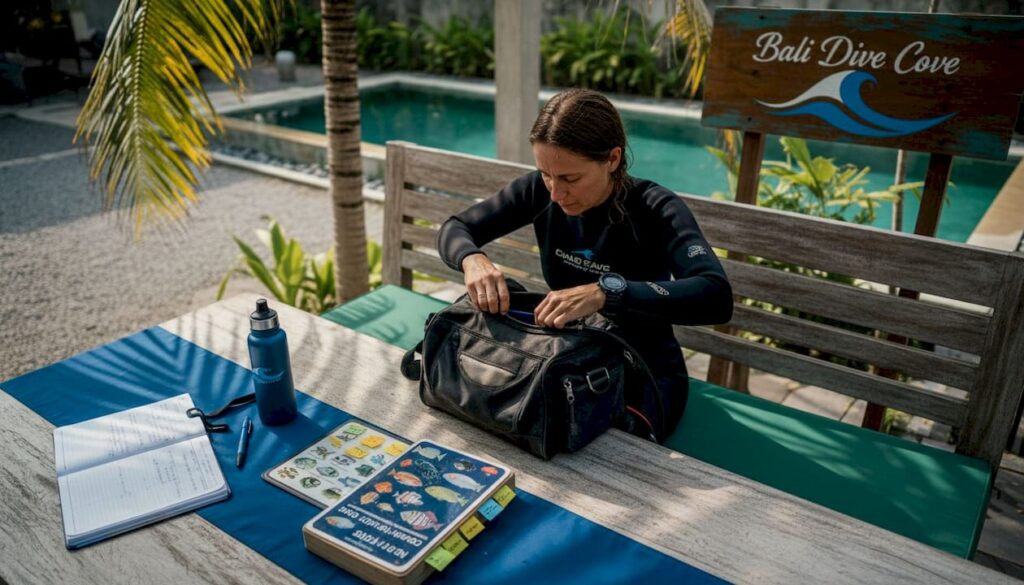
Now that you understand why identification matters, gather these tools before your first reef dive. Having the right resources in your bag makes the difference between a vague memory and a verified species list you can be proud of.
Field guides worth carrying
Physical books remain the gold standard for detailed reef fish identification. Two titles stand out for Indo-Pacific diving. The first is Reef Fish Identification: Tropical Pacific by Allen, Steene and colleagues, which covers more than 2,000 species and organises them by shape and behaviour, grouping disc-shaped colourful fish separately from slender schoolers. That structural approach mirrors exactly how you observe fish underwater. The second essential text is Gerald R. Allen’s A Field Guide to Tropical Reef Fishes of the Indo-Pacific, covering 1,670 species found across Indonesia and beyond.
For a free digital alternative, Florent’s Guide catalogues nearly 2,000 species and is searchable by region, making it excellent for quick post-dive cross-referencing.
| Resource | Species covered | Best use |
|---|---|---|
| Reef Fish ID: Tropical Pacific | 2,000+ | Comprehensive on-land reference |
| Allen’s Indo-Pacific Field Guide | 1,670 | Regional, portable, detailed |
| Florent’s Guide (online) | ~2,000 | Free, fast, searchable post-dive |
| Seabook App | 1,700+ | Offline, AI-powered, dive-ready |
| iNaturalist | Open database | Community verification |
Digital apps for modern divers
The Seabook app has become a favourite among serious reef fish enthusiasts. It carries over 1,700 species and uses AI photo recognition to suggest matches from your images. Crucially, it works offline, which matters enormously when you are diving in remote corners of Amed or along the coast towards Tulamben. You can filter by colour, pattern, behaviour, and depth, narrowing down a sighting in seconds. iNaturalist is equally valuable, though it relies on community input for verification rather than instant AI matching.
Many Bali dive operators also provide PADI Fish ID slates, which are laminated underwater checklists you can carry on a wrist lanyard. These slates help you tick off common families as you spot them rather than trying to remember everything until you surface. Our Bali marine life dive guide gives a strong overview of what families are most commonly encountered at Amed sites.
Camera and slate as identification tools
A compact underwater camera, even a basic action camera in a housing, is arguably the most powerful identification tool you own. A blurry photo is still better than no photo. A wrist slate with a pencil lets you sketch a rough outline or jot a key detail, such as “yellow tail, three vertical bars, hovered near sea fan at 14m.” That single note can confirm or rule out three candidate species when you check your field guide later.
Pro Tip: Before each dive, review the common families for that specific site. Five minutes of preparation on the boat makes your underwater observation far sharper and more focused.
Step-by-step: How to identify Bali reef fish underwater
With your toolkit ready, it is time to apply a stepwise approach while immersed among Bali’s reefs. The process below is designed to reduce cognitive overload so you stay relaxed, observe clearly, and retain the most useful information.
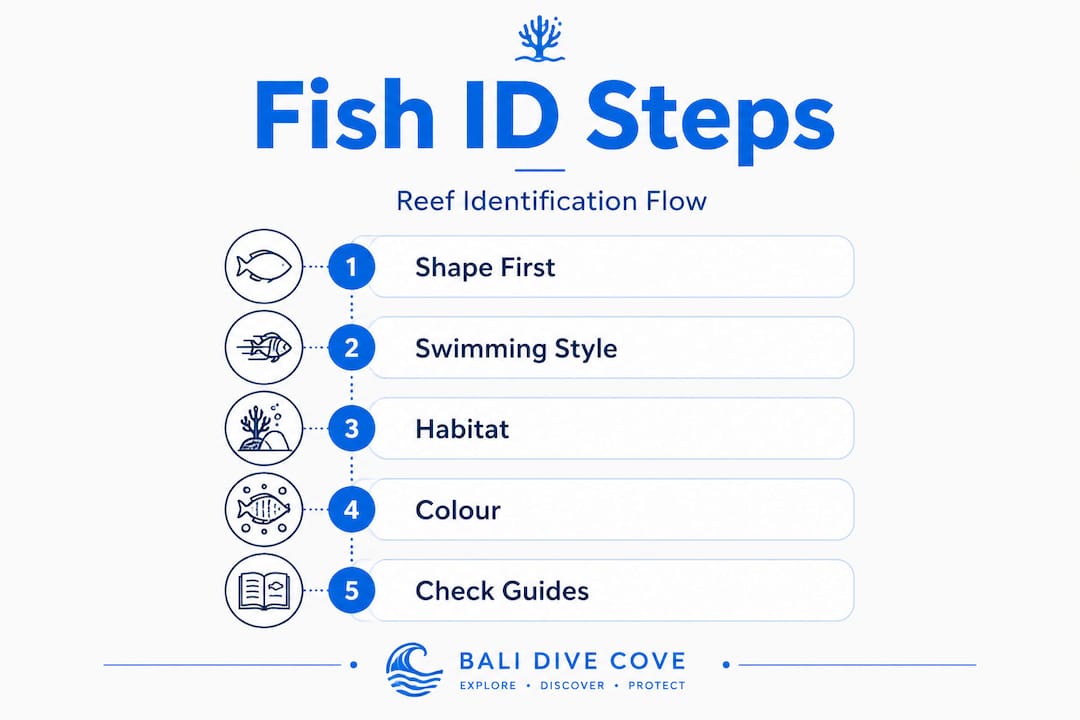
Step 1: Read the silhouette and swimming style first
When you spot an unfamiliar fish, resist the urge to immediately look for colour markings. Instead, notice the overall body shape. Is it deep-bodied and oval, like a butterflyfish or angelfish? Elongated and ribbon-like, suggesting a garden eel or pipefish? Flattened against the substrate, hinting at a flatfish or stonefish? Body shape is consistent across age, depth, and gender, while colour changes constantly.
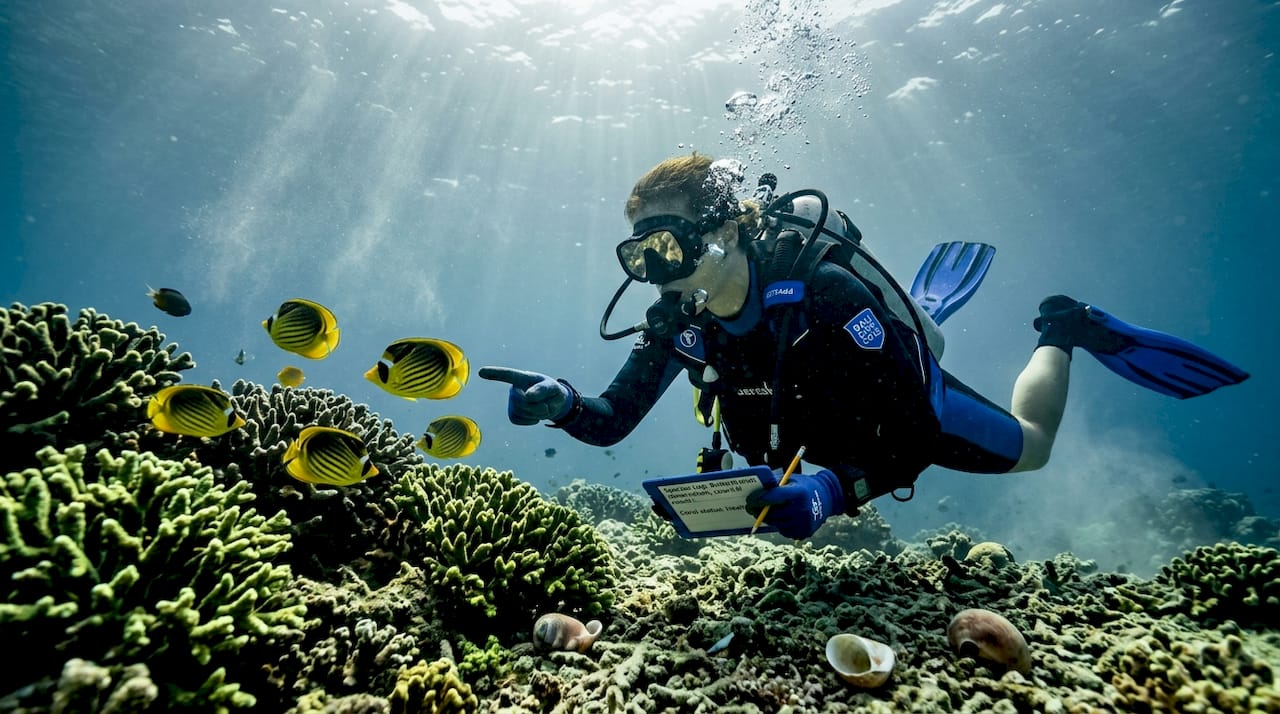
Swimming style is equally telling. Wrasses pulse their pectoral fins in a characteristic rowing motion. Parrotfish use the same technique but are much bulkier. Surgeonfish beat their tails steadily in open water. These movement patterns are visible from several metres away, long before you can read any colour detail.
Family-level identification is the fastest and most reliable approach for quick underwater recognition. Nailing the family first narrows your options from hundreds of species to perhaps ten or fifteen, which you can then refine on the surface.
Step 2: Note habitat and behaviour
Where is the fish? Reef fish are remarkably faithful to their preferred microhabitats. Hawkfish perch motionless on coral heads. Gobies sit on rubble. Lionfish hover mid-water near overhangs. Cleaning station wrasses perform exaggerated bobbing dances at known sites on the reef. Behaviour is a clue that experienced divers rely on heavily, because colour alone can mislead you.
Many species undergo dramatic ontogenetic colour changes, meaning juveniles look entirely different to adults. Juvenile emperor angelfish are dark blue with white concentric rings, while adults are striped in yellow and blue. If you only memorised the adult colouration, the juvenile looks like a completely different animal.
Step 3: Record details during calm moments
At a safety stop or during a rest on a sandy patch at depth, sketch a quick outline on your slate or take a reference photo. You do not need artistic skill. A rough oval with “three bars, yellow fin” is enough. Note the depth, the surrounding habitat, and roughly how many individuals were present.
“Prioritise family-level ID first for quick underwater recognition, then refine post-dive with photos, apps, and books. Expert divers use behaviour over colour because ontogenetic changes are common across reef fish families.”
Step 4: Save complex IDs for the surface interval
Accept that you will not identify every fish in real time. Amed’s reefs move fast, and chasing a positive ID can pull your attention away from buoyancy and safety. Capture what you can, mentally log the striking features, and plan to sit with your field guide during the surface interval. This unhurried approach also makes diving far more enjoyable.
For those interested in underwater photography for identification, using a macro lens setting on small, stationary subjects like gobies or blennies is a productive way to build a reference library over multiple dives.
Post-dive: Verifying and refining fish identifications
After surfacing, the identification journey continues. This is where your notes, photos, and field guides come together into real, lasting knowledge.
Comparing notes to guides and apps
Start by reviewing your slate notes and any photos while the dive is still fresh in your memory, ideally within the first hour. Open your field guide and work through the shape-based sections that match your observation. Cross-reference with the Seabook app’s AI matching tool by uploading your best photo. The app will return a shortlist of species ranked by likelihood, which you can then verify against the written description.
| Post-dive tool | Strength | Limitation |
|---|---|---|
| Field guide | Detailed illustrations, reliable | Time-consuming to search |
| Seabook AI match | Fast, visual, offline | Needs a reasonably clear photo |
| iNaturalist upload | Community expert verification | Can take hours or days |
| Checklist from dive op | Site-specific accuracy | Limited to common species |
Using iNaturalist for community confirmation
iNaturalist is a treasure trove for unusual sightings. Upload your photo with location data attached, and the platform’s community of naturalists and marine biologists can confirm or correct your ID. Observations near Amed and the Liberty Wreck in Tulamben are particularly active, so you may get a response surprisingly quickly. Over time, your personal observation record becomes a meaningful contribution to reef monitoring.
Good photo tips for fish ID include shooting with natural light where possible, aiming for a lateral profile of the fish, and capturing the dorsal fin pattern clearly. These details are what experts use to distinguish closely related species.
Building a personal species checklist
Maintain a running list across all your Amed dives, noting the site, depth, and date for each species. After five or six dives, you will notice patterns. Certain wrasses appear at every sandy site. Specific gobies are exclusive to the volcanic black sand of Amed’s main bay. This personalised checklist, refined over time with help from visibility and ID accuracy data, becomes far more valuable than any generic guide.
Common mistakes and expert tips for Bali fish identification
Even with the best intentions, novice and seasoned divers alike slip up. Here are the most frequent mistakes and how to avoid them.
-
Relying solely on colour. Colour is the least reliable identifier for reef fish. Two individuals of the same species can look radically different depending on age, sex, stress levels, and time of day. Learn the body shape and swimming movement first.
-
Skipping note-taking underwater. Memory fades within minutes of surfacing, especially after a stimulating dive. Even a single written word on a slate, such as “striped” or “hovered,” helps unlock the memory during post-dive review.
-
Assuming one species equals one look. Ontogenetic changes are common in reef fish, meaning juveniles, sub-adults, and adults of the same species may appear completely different. Always check the juvenile illustrations in your field guide.
-
Overlooking behaviour as a clue. A fish sitting perfectly still on a coral head is behaving very differently to one darting through open water. Behaviour narrows your identification options almost as much as body shape.
-
Trying to ID everything on every dive. Pick two or three target families per dive and observe them carefully. You will learn far more than if you frantically try to note every species you pass.
Pro Tip: Ask your dive guide to point out species they find unusual or particularly interesting. Experienced guides at Amed dive resorts carry years of site-specific knowledge that no app can replicate.
Good scuba diving preparation also includes reviewing your target species before the dive, so your brain is primed to notice them when they appear.
Why mastering family-first recognition transforms your Bali dives
Most identification guides hand you a list of species and tell you to memorise colour patterns. That approach rarely works underwater, and we think it misses the real secret to confident fish ID.
When you learn families before species, you reduce cognitive overload dramatically. Your brain does not need to search through hundreds of possibilities. Instead, it makes one broad match first. Is it a butterflyfish? Yes. Then which one? That two-stage process is far faster and far more accurate under the mild stress of an actual dive.
The deeper insight that most guides overlook is the role of post-dive refinement as the real engine of learning. Underwater, you collect raw observations. On the surface, you process them into permanent knowledge. Skipping the post-dive review means repeating the same identification guesses on dive after dive, never actually improving. The divers we have watched develop quickly are the ones who sit with their field guides and photos for thirty minutes after every dive, not just the ones who log the most underwater hours.
Behaviour over colour is the expert’s shortcut for a reason. A fish’s swimming style and habitat preference are far more stable than its pigmentation. Once you can read movement patterns, you start recognising species from a distance, even before you see their markings clearly.
Sharing your post-dive findings with your dive buddy or guide also sharpens your memory and your accuracy. Articulating what you saw forces you to organise your observations and often reveals gaps in your notes. That social loop is one of the most enjoyable parts of reef fish identification, and it turns every dive into a genuine learning experience rather than just a tick-box exercise.
Level up your Bali fish identification with expert-guided dives
Putting these skills into practice is far more rewarding with an experienced guide beside you. At Bali Dive Cove, our instructors have spent over 16 years diving Amed’s reefs and can point out species you would never spot alone, from tiny dragonets hiding in rubble to ribbon eels peering from their burrows.
Our small group Bali dive packages are tailored to give you relaxed, unhurried time on the reef, so you can observe, photograph, and learn at your own pace. For those who want a structured approach, our fish ID dive courses cover family recognition, underwater sketching, and post-dive verification in a format that suits both beginners and certified divers looking to sharpen their skills. Every dive we lead is a chance to see Amed’s extraordinary marine life through newly informed eyes.
Frequently asked questions
What is the easiest way to identify Bali reef fish underwater?
Focus on family first, using body shape and swimming behaviour rather than colour, then refine the species ID post-dive with photos and a field guide.
How many fish species could I see on a typical dive in Amed?
You can expect to encounter 50 to 100 species on a single dive in Amed’s reefs, making it one of the richest dive sites in the Indo-Pacific.
Are there identification apps that work offline in Bali?
Yes, Seabook works offline and offers AI photo matching alongside filters for colour, behaviour, shape, and depth, making it ideal for remote diving locations.
Should I bring a fish ID book or rely on technology?
Bring both. A dedicated field guide provides detailed illustrations and context, while an app offers fast AI matching, and together they cover every stage of the verification process.
How do I handle fish that change colour or shape?
Rely on swimming style and habitat rather than markings alone, then cross-reference with juvenile illustrations in your field guide, as ontogenetic colour changes are common across many reef fish families.
