


Many divers arrive in Bali eager to improve their underwater abilities but struggle without structured guidance. Practising skills like buoyancy control, navigation and emergency procedures requires more than enthusiasm. It demands expert instruction, controlled environments and personalised feedback. This guide walks you through preparing for, executing and verifying your underwater skill development in Bali’s world-class dive centres, where small instructor ratios and safety-focused training transform nervous beginners into confident, capable divers.
Key takeaways
| Point | Details |
|---|---|
| Structured courses enhance skills and safety | Formal training with experienced instructors provides real-time coaching and prevents dangerous habits |
| Small instructor-to-student ratios allow personalised feedback | Individual attention ensures each diver receives tailored guidance for their specific challenges |
| Safety procedures include buddy systems and controlled ascents | Comprehensive safety protocols protect divers whilst they practise new techniques underwater |
| Dry drills improve water efficiency | Practising skills on land before submerging builds muscle memory and reduces anxiety |
| Progression possible via PADI courses at Bali dive centres | Advanced certifications unlock deeper dives and more challenging underwater environments |
Understanding the essentials before practising underwater skills
Before you submerge to practise advanced techniques, you need solid foundations. Understanding your current certification level determines which skills you can safely attempt. Open Water divers shouldn’t jump straight into deep navigation or rescue scenarios. Check your logbook honestly. How many dives have you completed? What conditions have you experienced?
Physical fitness matters more than many divers realise. Underwater skill practice demands stamina, flexibility and cardiovascular health. Schedule a medical clearance if you haven’t dived recently or have health concerns. Your body needs to handle increased exertion whilst managing nitrogen absorption and pressure changes.
Equipment familiarity prevents underwater panic. You should operate your BCD, regulator and dive computer instinctively. Fumbling with gear whilst trying to master new skills creates dangerous distractions. Spend time on land adjusting straps, testing releases and memorising where everything sits. This preparation directly impacts your underwater performance.
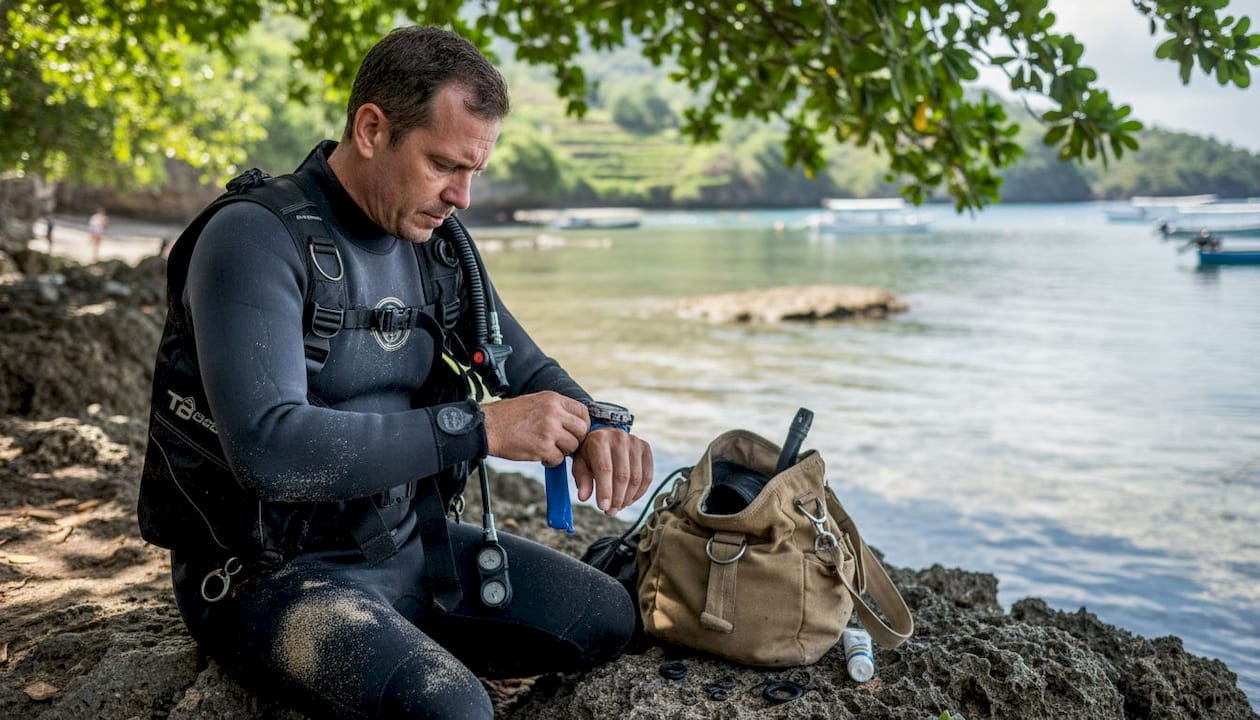
Bali’s dive sites vary dramatically in depth, current strength and visibility. Amed’s reefs differ from Tulamben’s wrecks. Research your chosen location through a scuba diving preparation workflow that covers site-specific conditions. Knowing what to expect reduces anxiety and lets you focus on skill development rather than environmental surprises.
Dry drills revolutionise underwater efficiency. Practise breathing patterns, equipment checks and emergency procedures on land. Rehearse clearing your mask, recovering your regulator and achieving neutral buoyancy positions without water pressure. These repetitions build neural pathways that function automatically when you’re 15 metres down.
Pro Tip: Film yourself performing dry drills on your phone. Watching your movements reveals inefficiencies you can’t feel in the moment, like excessive arm movements or poor body positioning.
Key preparation steps include:
- Verify certification level matches planned skill practice
- Complete medical clearance within 12 months
- Test all equipment in controlled conditions
- Study dive site conditions and potential hazards
- Rehearse emergency procedures until they’re automatic
The difference between structured courses with real-time coaching and casual diving becomes obvious when complications arise. Proper preparation transforms potential emergencies into manageable situations you’ve already practised.
Step-by-step guide to practising underwater skills safely in Bali
Every successful skill practice session starts with a thorough pre-dive briefing. Arrive early to discuss your specific learning goals with your instructor. Want to improve your buoyancy control? Need help with compass navigation? Communicate these objectives clearly. Instructors tailor their guidance when they understand your priorities.
The buddy check ritual prevents equipment failures before they threaten your safety. Work through the systematic verification process with your dive partner. Check air supply, releases, weights and backup equipment. This isn’t theatre. Equipment malfunctions cause real emergencies. Buddy systems and pre-dive briefings form your first defence against underwater incidents.
Underwater communication becomes critical during skill practice. Review hand signals before descending. Establish clear indicators for “stop”, “problem”, “ascend” and “I’m okay”. Instructors watch for subtle signs of stress or confusion. Maintain eye contact and respond promptly to signals. Silent communication builds trust and prevents misunderstandings that escalate into panic.
Core skill practice follows a logical progression:
- Achieve neutral buoyancy at your target depth before attempting other skills
- Practise controlled breathing to stabilise your position in the water column
- Execute trim adjustments by shifting weight distribution and body position
- Navigate short distances using natural references and compass bearings
- Perform emergency drills like regulator recovery and mask clearing
- Practise controlled ascents with proper safety stops
Each skill deserves focused attention. Don’t rush through multiple techniques in one dive. Master one element before adding complexity. Your instructor monitors your progress and adjusts difficulty accordingly.
“Small instructor-to-student ratios ensure every diver receives immediate feedback when technique falters, preventing bad habits from becoming ingrained patterns.”
Controlled ascents require discipline most divers underestimate. Ascend no faster than 9 metres per minute. Watch your dive computer constantly. Stop at 5 metres for a safety stop lasting at least 3 minutes. These procedures prevent decompression sickness regardless of your dive profile. Never skip safety protocols because you feel fine.
Post-dive analysis cements learning. Review your dive computer data with your instructor. Which depth did you struggle to maintain? Where did your air consumption spike? Recording these observations in your logbook creates a progress map. Patterns emerge over multiple dives, revealing exactly which skills need more practice.
Pro Tip: Ask your instructor to video your underwater skills practice. Watching yourself reveals body positioning issues and inefficient movements you can’t perceive whilst concentrating on the task.
Bali’s dive courses structure this progression systematically. Rather than guessing which skills to practise, follow curriculum designed by diving education experts. The PADI Advanced Open Water course specifically targets intermediate skill development through supervised practice in varied conditions.
Common challenges and how to troubleshoot your underwater skills
Anxiety underwater manifests as rapid, shallow breathing that depletes your air supply and destabilises buoyancy. When nerves strike, stop all activity. Focus exclusively on slow, deep breaths. Count to four on each inhale and exhale. Your instructor will wait patiently whilst you regain composure. Hyperventilation creates a dangerous feedback loop where panic breeds more panic.
Buoyancy control frustrates more divers than any other skill. You sink when you want to hover. You rocket upward when you try to descend. The solution lies in tiny BCD adjustments and breath control. Add air in half-second bursts, then wait 10 seconds for the effect. Exhale partially to descend slightly. Your lungs function as a fine-tuning mechanism for the rough adjustments your BCD makes.
Trim problems cause excessive drag and rapid fatigue. Horizontal body position minimises resistance and conserves energy. If your legs sink, shift weights forward or adjust your cylinder position. If your head drops, move weights backward. Small equipment repositioning creates dramatic improvements in water efficiency.
Equipment malfunctions test your training. A free-flowing regulator wastes air rapidly. Switch to your alternate air source calmly, signal your buddy and begin a controlled ascent. Lost fin? Buddy breathe whilst your partner retrieves it. Every equipment scenario has a practised response. Panic only occurs when you haven’t rehearsed solutions.
Common troubleshooting approaches include:
- Breathing issues: Slow respiratory rate, focus on exhalation duration
- Buoyancy instability: Make smaller BCD adjustments, use breath control for fine-tuning
- Navigation errors: Verify compass calibration, use natural references as backups
- Equipment problems: Execute emergency procedures methodically, never rush
Scuba and freediving require different skill sets. Scuba divers manage equipment and gas supply. Freedivers focus on breath-hold capacity and equalisation efficiency. Don’t assume skills transfer directly between disciplines. Each demands specific training and safety protocols.
The PADI Advanced Open Water course includes 5 dives targeting deep diving and navigation skills. These structured experiences expose you to challenging conditions with expert supervision. When self-directed practice reveals persistent difficulties, formal training provides breakthrough moments.
Rescue Diver certification becomes essential when you want to handle emergencies confidently. This advanced training teaches victim recognition, emergency management and rescue techniques. The skills you learn protect your dive buddies and build the situational awareness that prevents incidents before they escalate.
| Challenge | Scuba solution | Freediving solution |
|---|---|---|
| Equalisation difficulty | Descend slower, use multiple techniques | Perfect Frenzel manoeuvre, pre-dive preparation |
| Buoyancy at depth | BCD inflation, weight adjustment | Lung volume control, streamlined position |
| Emergency ascent | Controlled ascent with safety stop | Immediate surface, recovery breathing |
| Anxiety management | Buddy support, equipment redundancy | Mental training, gradual depth progression |
Measuring progress and what to expect from your enhanced underwater skills
Tracking improvement requires objective metrics beyond “feeling better underwater”. Your instructor provides structured feedback after each training dive. Did you maintain target depth within one metre? How many times did you need buoyancy corrections? Concrete measurements reveal progress that subjective feelings obscure.
Air consumption rates indicate efficiency gains. New divers burn through a 12-litre cylinder in 30 minutes. Experienced divers with refined skills extend the same cylinder to 60 minutes at identical depths. Track your surface air consumption rate across multiple dives. Declining numbers prove your breathing control and reduced exertion are working.
Buoyancy precision transforms your diving experience. Initially, you oscillate through a 3-metre range whilst trying to hover. With practice, you maintain position within 30 centimetres. This stability lets you photograph marine life, navigate tight spaces and conserve energy during long dives.
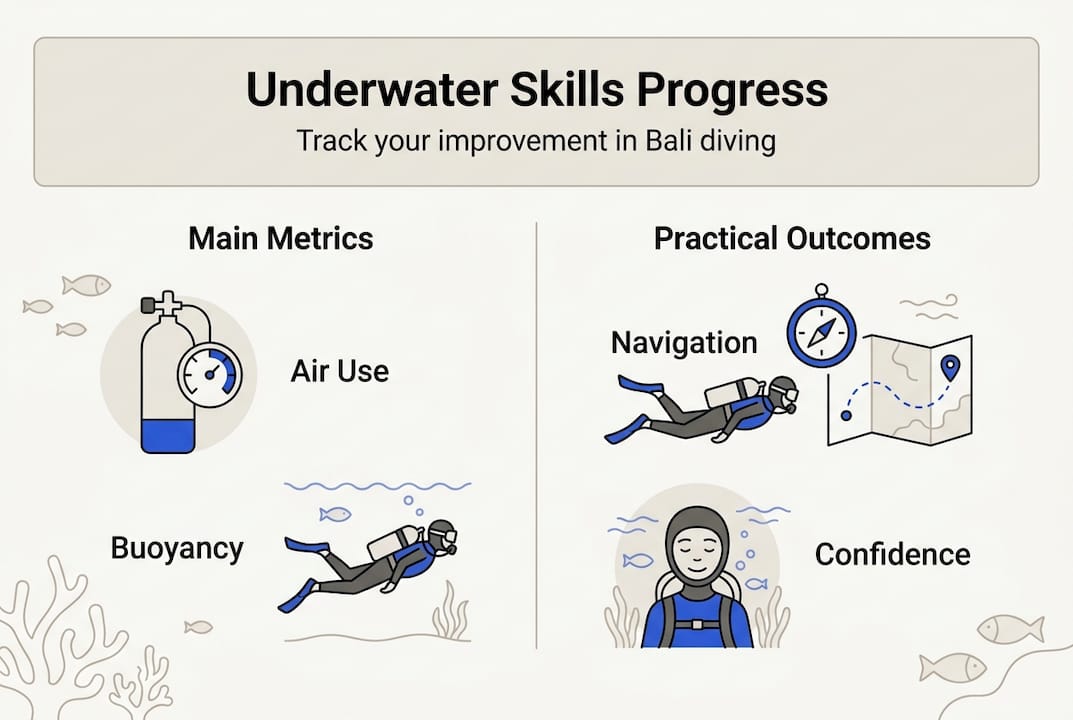
Navigation confidence opens new dive sites. Compass skills and natural navigation techniques let you explore unfamiliar reefs safely. You plan dive routes, execute them accurately and return to your entry point without surfacing. This competence grants access to sites where surface support isn’t constantly available.
Emergency response capabilities provide genuine safety improvements. You can share air calmly, assist a panicked diver and manage equipment failures without instructor intervention. These skills make you a valuable dive buddy rather than a liability requiring constant supervision.
Expected skill progression timeline:
- Dives 1-10: Basic buoyancy control, comfortable equipment operation
- Dives 11-25: Refined trim, efficient air consumption, basic navigation
- Dives 26-50: Advanced navigation, emergency management, speciality skills
- Dives 50+: Instructor-level competence in core skills, ready for technical diving
| Skill area | Beginner performance | Intermediate performance | Advanced performance |
|---|---|---|---|
| Buoyancy control | ±3 metres variation | ±1 metre variation | ±30 centimetres variation |
| Air consumption | 180 bar in 30 minutes | 120 bar in 40 minutes | 80 bar in 50 minutes |
| Navigation accuracy | 45° compass deviation | 15° compass deviation | 5° compass deviation |
| Emergency response | Requires instructor help | Manages with buddy | Assists other divers |
Enhanced skills permit access to advanced dive sites. Deep wrecks, strong current dives and cave systems require demonstrated competence. Dive operators verify certification levels and logged experience before permitting challenging dives. Your improved abilities aren’t just personal satisfaction. They’re credentials that unlock premium underwater experiences.
The PADI Advanced Open Water course provides specific dives that validate your progression. Deep diving and navigation specialities prove you can handle conditions beyond recreational limits. These certifications appear in your logbook as verifiable evidence of capability.
Further education opportunities include speciality courses in night diving, wreck diving and underwater photography. Each builds on core skills whilst adding new dimensions to your diving. The advanced courses available in Bali create clear pathways from intermediate competence to expert-level mastery.
Confident, efficient diving transforms every underwater experience. You notice marine life instead of fixating on your gauges. You explore diverse sites without anxiety. You enjoy longer bottom times and safer ascents. These improvements compound over your diving career, making every subsequent dive more rewarding than the last.
How Bali Dive Cove supports your underwater skill development
Developing underwater skills demands more than reading guides and watching videos. You need experienced instructors who recognise your specific challenges and provide immediate corrections. Bali Dive Cove’s small group ratios ensure you receive focused attention during every training dive. Our instructors don’t just demonstrate techniques. They watch your execution, identify inefficiencies and guide you through corrections until movements become automatic.
Our dive courses progress systematically from foundational skills to advanced competencies. Whether you’re completing your initial certification or pursuing speciality ratings, structured curriculum ensures you build capabilities in the correct sequence. The PADI Advanced Open Water course specifically targets intermediate divers ready to refine buoyancy, navigation and deep diving skills through supervised practice.
Amed’s protected reefs and varied dive sites provide ideal training conditions. Calm waters let you focus on skill development without fighting currents or poor visibility. As your abilities improve, we introduce more challenging environments that test your competence safely. Our dive packages combine skill practice with exploration, letting you apply new techniques whilst discovering Bali’s underwater treasures. Book with us to transform your diving from cautious survival into confident mastery.
How to practise underwater skills: frequently asked questions
What is the best way to start practising underwater skills?
Enrol in a structured course with qualified instructors who provide real-time feedback. Self-directed practice without expert guidance often reinforces poor technique. Start with foundational skills like buoyancy and trim before attempting advanced manoeuvres.
How can I improve buoyancy control effectively?
Make tiny BCD adjustments and use breath control for fine-tuning. Add air in half-second bursts, then wait for the effect before adding more. Practise holding specific depths for extended periods, gradually reducing your depth variation.
Are there safety measures during skill practice in Bali?
Yes, comprehensive protocols include buddy systems, pre-dive briefings, controlled ascents and small instructor-to-student ratios. All skill practice occurs under direct supervision with emergency procedures established before every dive.
Can I receive personalised feedback during dive courses in Bali?
Absolutely. Small group sizes at quality dive centres ensure instructors observe your technique closely and provide individual corrections. Video analysis helps you see positioning issues you can’t perceive underwater.
What courses help advance my underwater skills after beginner level?
PADI Advanced Open Water develops navigation and deep diving competencies. Rescue Diver certification teaches emergency management. Speciality courses in night diving, wreck diving and underwater photography add focused skills to your repertoire.
