


TL;DR:
- Underwater navigation skills help divers stay oriented and reliably return to their starting point, especially since GPS is unavailable underwater.
- Using both compass and natural cues, divers develop a systematic workflow that enhances safety, independence, and enjoyment during dives.
Think you can simply follow your dive buddy back to the boat? Many divers assume that staying close to the group or glancing at a dive computer is enough to find their way underwater. The reality is very different. GPS is unavailable underwater, and even the most advanced dive computers cannot give you turn-by-turn directions back to shore or your entry point. Whether you are planning a liveaboard trip around Nusa Penida or exploring the famous USAT Liberty wreck in Amed, knowing how to navigate is the difference between a confident, enjoyable dive and a stressful, disorienting one. This guide unpacks what underwater navigation actually means, which techniques matter most, and how you can learn these skills right here in Bali.
Key Takeaways
| Point | Details |
|---|---|
| Navigation isn’t automatic | Scuba divers must use trained skills because GPS does not work underwater. |
| Combine compass and environment | Using both a compass and natural references is essential for safe, effective underwater navigation. |
| Bali offers ideal training | Bali’s dive sites and PADI courses provide excellent opportunities to learn navigation for all levels. |
| It’s a workflow, not a gadget | Successful navigation comes from habits and disciplined execution, not just using a device. |
What is underwater navigation?
Underwater navigation sounds technical, but at its heart it is simply the set of skills that allow you to stay oriented beneath the surface and reliably return to your starting point. According to PADI, underwater navigation is “the set of skills and methods divers use to maintain orientation underwater and reliably return to a starting point (boat/shore/dive area) even when GPS is unavailable.”
Here is why this matters so much: the moment you slip below the surface, your usual landmarks disappear. Roads, buildings, and signposts are gone. Visibility can drop to a few metres in strong currents or murky water. Even in crystal-clear conditions, many reef sections look remarkably similar to one another, especially to a less experienced eye.
A common misconception among new divers is that navigation is a skill reserved for professionals or technical divers. That simply is not true. Navigation awareness is relevant for every diver, from the person completing their very first open-water dive to the seasoned explorer checking out a new reef. In fact, if you are planning a Bali underwater adventure, the region’s complex reef systems, variable currents, and varied site layouts make navigation skills genuinely essential, not just a nice-to-have.
“Underwater navigation is not about being technical or elite. It is about being a safe, confident, and independent diver who can enjoy the underwater world without constantly relying on others to find the way back.”
Key reasons every diver benefits from navigation skills:
- Reduced anxiety: Knowing where you are and where you are going allows you to relax and enjoy the marine life around you.
- Better air management: Disoriented divers often breathe faster due to stress, consuming their air supply more quickly.
- Greater independence: You can lead dives, explore new sites with confidence, and handle situations when your buddy gets separated.
- Improved safety: You are far less likely to surface in a dangerous location far from the boat or shore.
- Enhanced dive planning: Good navigators plan more efficient routes, maximising bottom time and covering the best sections of a reef.
Core skills: Compass and natural navigation methods
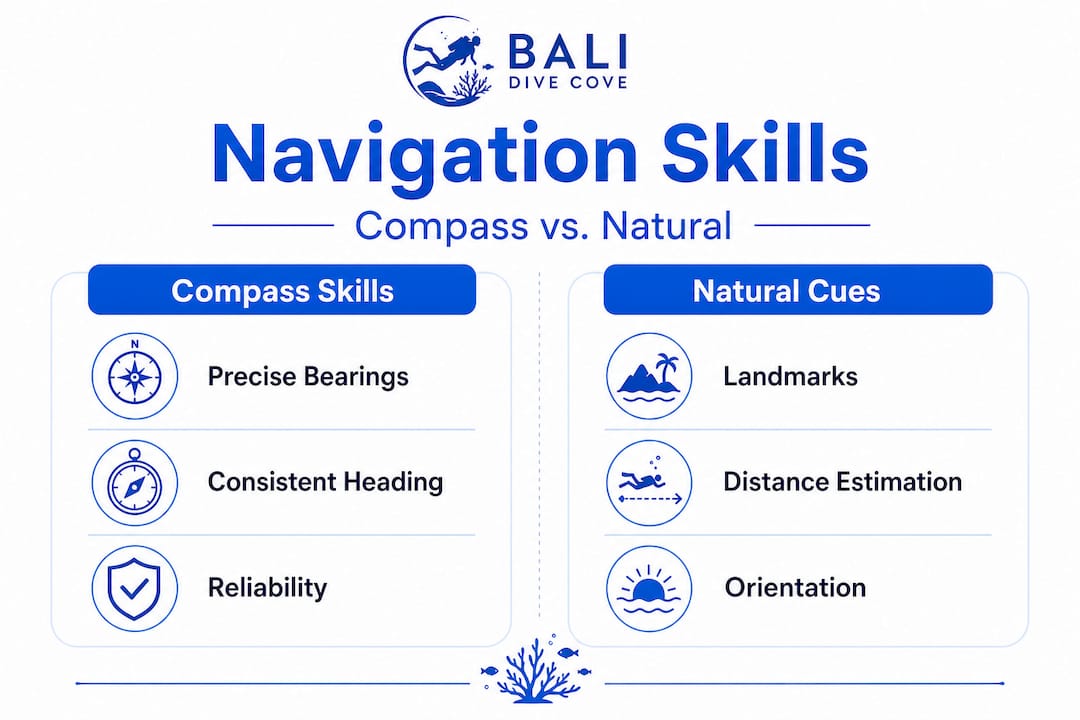
Once you understand why navigation matters, it is time to look at how it actually works. Core navigation mechanics combine compass navigation, including bearings, reciprocal headings, and distance estimation, with natural navigation using environmental cues such as terrain, light, and other references. These two approaches work best together, and skilled divers learn to use both simultaneously.
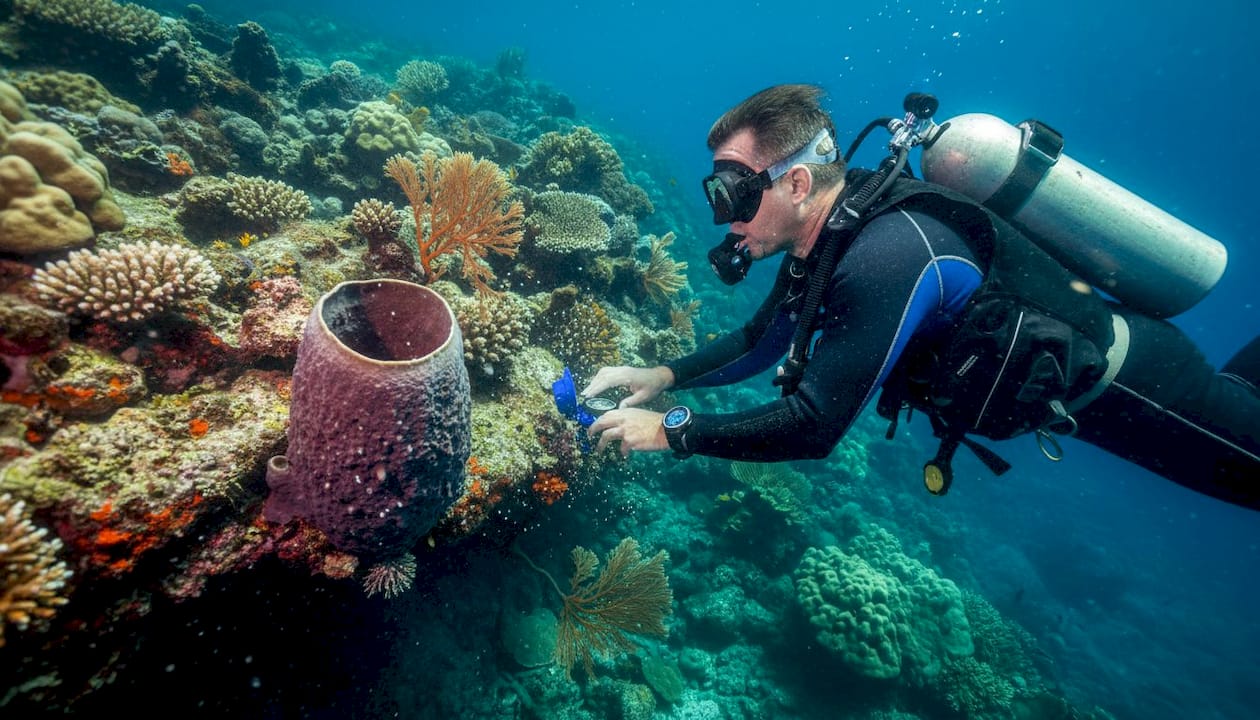
Compass navigation is the backbone of underwater wayfinding. A compass gives you a reliable reference point regardless of visibility or conditions. You take a heading (a specific degree reading) when you leave your entry point, then use that reading to swim a consistent course. When it is time to turn back, you use the reciprocal heading, which is simply 180 degrees opposite your original bearing. For example, if you headed out at 045 degrees (north-east), your return heading is 225 degrees (south-west). Estimating distance while swimming is also a key part of compass navigation. Most divers learn to count their kick cycles and relate them to approximate distances, a technique known as kick-cycle calibration.
Natural navigation uses the environment itself as a guide. This includes:
- Terrain features: Rocks, coral formations, sand channels, and reef walls that you can recognise and use as landmarks.
- Light direction: Sunlight typically comes from above and at an angle depending on the time of day. In shallower water especially, observing light can help you maintain a general sense of direction.
- Current: Water current flows consistently in a particular direction, and experienced divers use this to confirm their heading and adjust for drift.
- Marine life behaviour: Some species congregate on specific sides of a reef or respond to current and light, offering subtle environmental clues.
| Method | Advantages | Disadvantages |
|---|---|---|
| Compass navigation | Reliable in any visibility; precise headings; works in open water | Requires practice; can be affected by nearby metal; does not account for currents |
| Natural navigation | Builds situational awareness; no equipment needed; intuitive over time | Relies on visibility and distinctive terrain; can be misleading in similar-looking reef areas |
Both methods have their strengths. Compass navigation is more precise but mechanical. Natural navigation is more holistic but depends on the environment.
Pro Tip: Always calibrate your compass before each dive and check it away from metal equipment like your cylinder. But never switch off your environmental awareness. Combining both methods gives you a reliable cross-check throughout every dive.
You can also read more about putting these techniques into practice in our reef diving tips for beginners, which covers common situations you will encounter on Bali’s reefs.
The underwater navigation workflow
Knowing the techniques is one thing. Applying them systematically on every dive is another. The best navigators do not just carry a compass and hope for the best. They follow a consistent workflow that begins before they even enter the water. Treating navigation as an integrated workflow, covering briefing, route planning, heading discipline, distance and time calibration, and environmental references, is what separates reliable navigators from those who occasionally get lucky.
Here is a typical underwater navigation cycle that well-trained divers follow:
- Pre-dive briefing: Review the dive site map or guide. Note entry and exit points, depth contours, and any significant terrain features. Understand where the current is running and how it may affect your route.
- Set your compass heading: At the entry point, note your initial compass heading before descending. This becomes your baseline for the entire dive.
- Confirm natural references: As you descend, note the slope of the reef, the direction of current, and any distinctive terrain features that you can identify on your return.
- Swim to your planned waypoints: Follow your heading and count kick cycles to estimate distance. Pause at recognisable landmarks to confirm your position.
- Re-confirm regularly: Every few minutes, check your compass heading against your environmental cues. If they disagree, investigate why before continuing.
- Plan your turn: Know your turnaround time or air pressure before you leave, and stick to it regardless of how interesting the reef looks.
- Return using reciprocal heading: Take your return bearing, re-confirm with natural cues, and swim back to the ascent point calmly and methodically.
“Navigation is not a moment. It is a habit woven through every stage of a dive, from the briefing table to the final safety stop.”
Pro Tip: Regularly re-confirm your bearings using both compass and environmental cues, particularly at any point where you change direction. Many divers get disoriented at the turnaround because they rely solely on memory rather than actively verifying their new heading.
Good preparation is a significant part of this workflow. You can find a detailed look at how to approach this in our dive preparation workflow guide, which walks through the full process from kit checks to in-water checks.
Learning underwater navigation in Bali
Bali is an exceptional place to learn navigation because of its sheer variety of environments. From the sheltered bays of Amed to the powerful drift dives around Nusa Penida, the island offers conditions that suit every stage of learning, from your first compass exercise in calm water to applying full navigation workflows in demanding drift dives alongside manta rays.
The PADI Underwater Navigator specialty course is the most structured way to develop these skills, and it is available right here in Bali. The course is designed to take you from the basics through to confident, independent navigation across a variety of conditions.
| Course component | What you learn | Where it is practised in Bali |
|---|---|---|
| Online theory module | Navigation principles, compass use, natural cues | At home or your accommodation before arriving |
| Pool or confined water session | Compass handling, kick-cycle calibration, basic patterns | Calm, shallow water in Amed or sheltered bays |
| Open-water navigation dives | Applying compass and natural navigation on real dives | Bali reefs such as Amed, Tulamben, or Padangbai |
| PADI specialty certification | Demonstrates competency in navigation skills | Awarded after completing all dives and assessments |
The online component typically takes two to four hours and can be completed before you arrive in Bali, saving valuable in-water time for practical learning. The full course generally spans two to three days, which fits perfectly into a week-long diving holiday.
Bali’s conditions add a layer of real-world complexity to your learning. Currents at sites like Nusa Penida mean you must account for drift when setting and maintaining headings. Diverse reef structures around Amed offer excellent practice for natural navigation using terrain, with walls, sandy channels, and coral bommies providing clear, distinctive landmarks. Learning in these conditions means you leave Bali not just with a certification but with genuinely practical, tested skills.
When booking a navigation course in Bali, here is what to look for:
- Small group sizes: Personal attention makes a significant difference when learning navigation. Smaller groups mean more time with your instructor.
- Experienced local instructors: Knowledge of the specific sites and conditions in Amed, Tulamben, or Padangbai is invaluable.
- Flexible pacing: Navigation takes practice and repetition. Avoid courses that rush through the content in a single day.
- Combined PADI certification options: Many divers combine the Underwater Navigator specialty with an Advanced Open Water course to maximise their time and earn a broader certification.
- Quality equipment: Check that the dive centre provides reliable, well-maintained compasses for training dives.
Why true underwater navigation is more than just the compass
Here is something we have noticed after years of guiding and teaching divers in Amed: beginners almost always fixate on the compass. They hold it at arm’s length, stare at it constantly, and treat it as the only tool they need. It is understandable. The compass is tangible and reassuring. But it is also incomplete.
The divers who navigate well are not the ones who are best at reading a compass. They are the ones who have developed a continuous, relaxed awareness of everything around them. They notice that the current shifted slightly, that the coral slope dropped off to the left, that the light is now coming from a different angle. They cross-reference that information with their compass automatically, without even thinking about it.
Because GPS cannot function reliably underwater, divers rely on what is sometimes called dead reckoning, tracking position by combining known headings, estimated distances, and environmental reference checks. This is not a single skill. It is a collection of small disciplines that, once practised enough, become second nature.
The uncomfortable truth is that many divers complete a navigation course and then stop practising. They assume the certification has done the work. Real navigation confidence comes from applying these habits on every dive, not just the ones with “navigation” in the title. If something feels wrong on a dive, whether a heading does not match the terrain or a landmark is missing, that instinct is your navigation awareness speaking. Trust it.
When things do go unexpectedly during a dive, having a solid navigation foundation helps enormously. We cover how to handle those moments in our guide to troubleshooting dive issues in Bali. Good navigation and good problem-solving go hand in hand.
Take your first navigation dive in Bali
Ready to put these skills into practice on Bali’s extraordinary reefs? At Bali Dive Cove, we offer PADI courses from beginner to specialty level, including the Underwater Navigator course, all led by instructors with over 16 years of experience in Bali’s waters. Our small-group approach means you get the personal attention you need to genuinely build these skills, not just tick a box.
Whether you are just starting out or looking to sharpen your navigation for more challenging sites, our dive courses in Bali are designed to move at your pace, in the right conditions, with clear guidance throughout. You can also explore our dive packages in Bali to combine navigation training with some of East Bali’s most spectacular dive sites. Get in touch with us and we will help you find the course and itinerary that fits your goals.
Frequently asked questions
Why can’t you use GPS to navigate underwater?
GPS signals do not penetrate water effectively, so they cannot provide real-time positioning below the surface. PADI notes that GPS-equipped dive computers can record only the entry point and cannot guide you directly back to the boat or shore without surfacing.
How long does it take to learn underwater navigation?
The PADI Underwater Navigator course typically spans two to three days and combines online study with required open-water navigation dives. PADI describes the online portion as taking approximately two to four hours before you get in the water.
Is underwater navigation hard for beginners?
It can feel challenging at first, but most beginners build solid confidence quickly with proper guidance. The PADI Underwater Navigator course teaches you to use both natural references and a compass together, making the learning process gradual and practical.
What are the conditions like for learning navigation in Bali?
Bali offers an impressive range of environments for navigation practice. Bali dive destinations include everything from gentle, sheltered bays ideal for beginners to advanced drift sites with strong currents, such as those found around Nusa Penida, where navigation becomes genuinely demanding and rewarding.
