

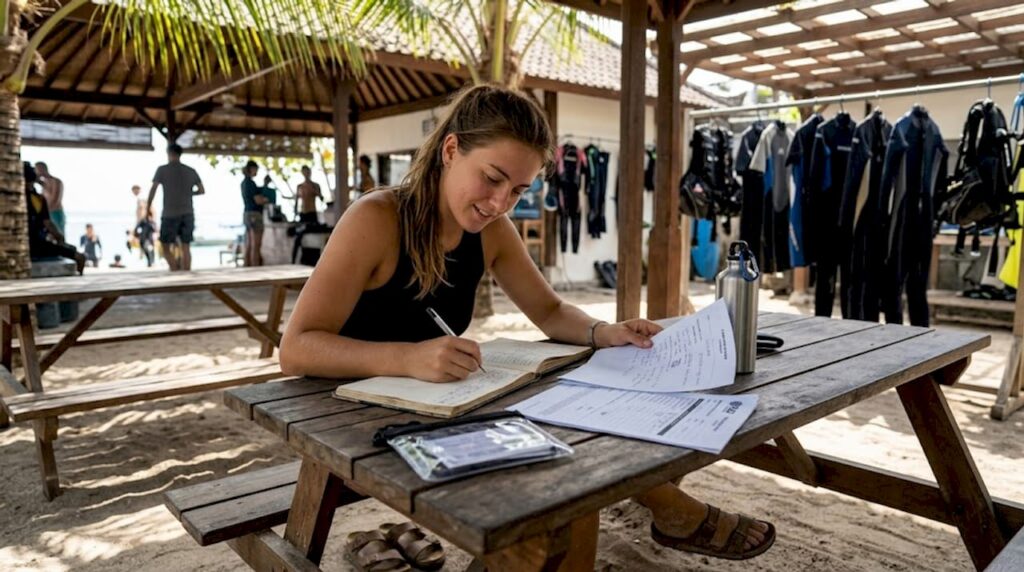
TL;DR:
- Referral dives allow completing training at multiple locations, saving holiday time in Bali.
- Proper documentation and advance communication ensure smooth completion of open water dives.
- The system offers flexibility, ideal for busy travelers, families, and those seeking local reef exploration.
Planning a diving trip to Bali but haven’t quite finished your PADI certification yet? You might be closer to your first open water dive than you think. A referral dive is a formal training-completion pathway that lets you split your certification across different locations, so you can complete theory and pool sessions at home, then finish your open water dives somewhere spectacular, like the reefs of Amed in East Bali. It’s a flexible, practical approach that suits modern travellers perfectly. This guide explains exactly what a referral dive is, how the process works, who benefits most, and how to make it happen seamlessly in Bali.
Key Takeaways
| Point | Details |
|---|---|
| Referral dive means flexible training | You can start your PADI certification at home and finish the open water dives in Bali or another destination. |
| Ideal for travel and timing | Referral dives are great for holiday-makers who want to maximise water time and reduce classroom sessions abroad. |
| Choose the right dive centre | Successful referral certification in Bali depends on good communication and choosing a reputable dive operator. |
| Prepare essential documents | Bring all training records and forms to ensure a smooth handover for your Bali referral dives. |
Defining a referral dive: what it really means
The word ‘referral’ causes no end of confusion. Most people hear it and picture a friend recommending a product, or a marketing incentive. In the world of scuba diving, it means something entirely different.
A referral in scuba diving is a formal certification pathway issued by a dive instructor or centre, allowing a student to complete their remaining training requirements at a different dive facility.
In simple terms, your original instructor or dive school issues a referral document once you’ve completed certain stages of your course. That document is then handed to a new instructor at your chosen destination, who picks up exactly where training left off. No repeating theory. No starting from scratch.
Here’s why this matters for scuba diving certification courses and travellers in particular:
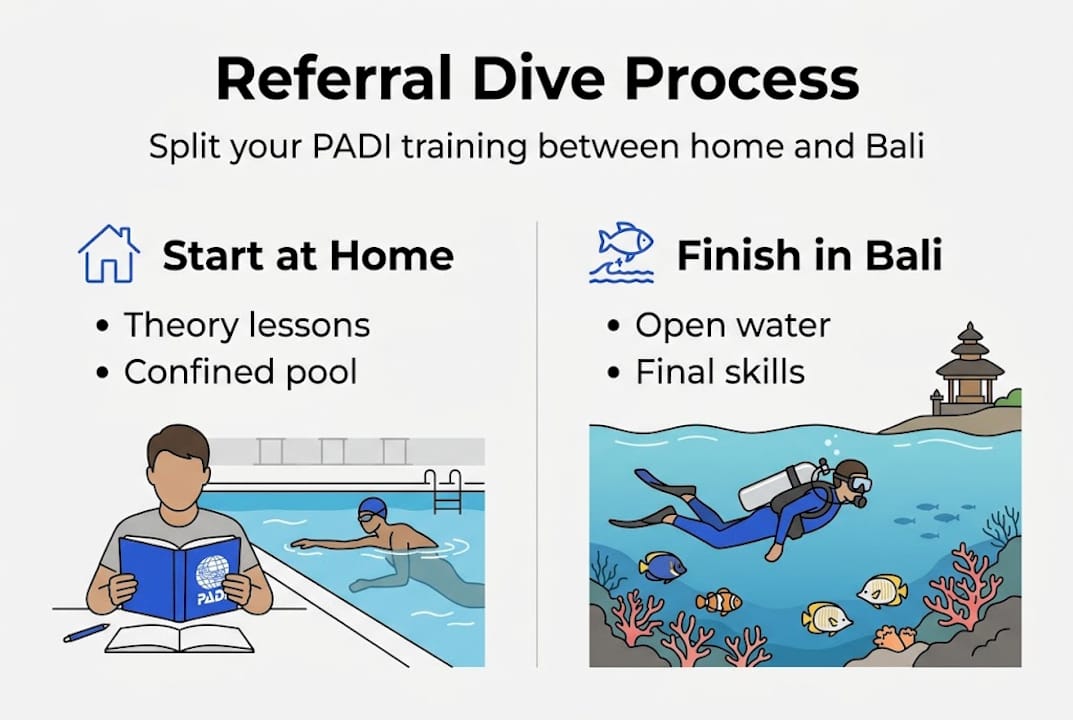
- You complete knowledge development (theory) and confined water dives (pool sessions) at home, at your own pace.
- You travel to Bali with your referral paperwork in hand.
- A local dive centre verifies your documentation and leads you through your open water dives in actual ocean conditions.
- You earn your full PADI certification without losing valuable holiday time to classroom work.
The key distinction is that this is a structured, regulated process within PADI’s global training framework. It’s not an informal arrangement. Instructors at the receiving end follow specific protocols to review your progress, assess your skills, and ensure you’re ready to dive safely. The whole system is designed so that your certification standards remain consistent, regardless of which country you’re in when you finish.
For travelling divers, this flexibility is genuinely transformative. Instead of spending your first two days in Bali in a pool or classroom, you arrive confident, prepared, and ready to explore vibrant coral reefs from day one. Amed’s walls, wrecks, and macro critters await. The only thing standing between you and them is your open water checkout dives.
How the referral dive process works
Understanding what a referral dive is makes the next question obvious: how do you actually do it? Here’s a clear breakdown of the typical stages:
- Start your PADI course at home. Enrol with a local dive centre and complete your knowledge development, which covers theory such as dive physics, equipment, and safety procedures.
- Complete confined water dives. These are pool sessions where you practise key skills: clearing your mask, controlled breathing, buoyancy basics. Your instructor signs off each skill.
- Receive your referral documentation. Once confined water training is done, your instructor issues a referral form that records your progress, certifies your completed skills, and confirms you’re ready for open water.
- Book your Bali dive centre. Contact your chosen centre in advance, confirm they accept referrals, and share your documentation before you arrive.
- Complete open water dives in Bali. Your local instructor reviews your referral, may conduct a brief skills check, and then guides you through four open water certification dives.
A referral allows you to finish confined water and theory at one dive centre and complete open water dives elsewhere, which is precisely what makes it so appealing for anyone planning a trip to Bali. Read through the beginner’s scuba diving steps to understand what each stage involves before you start.
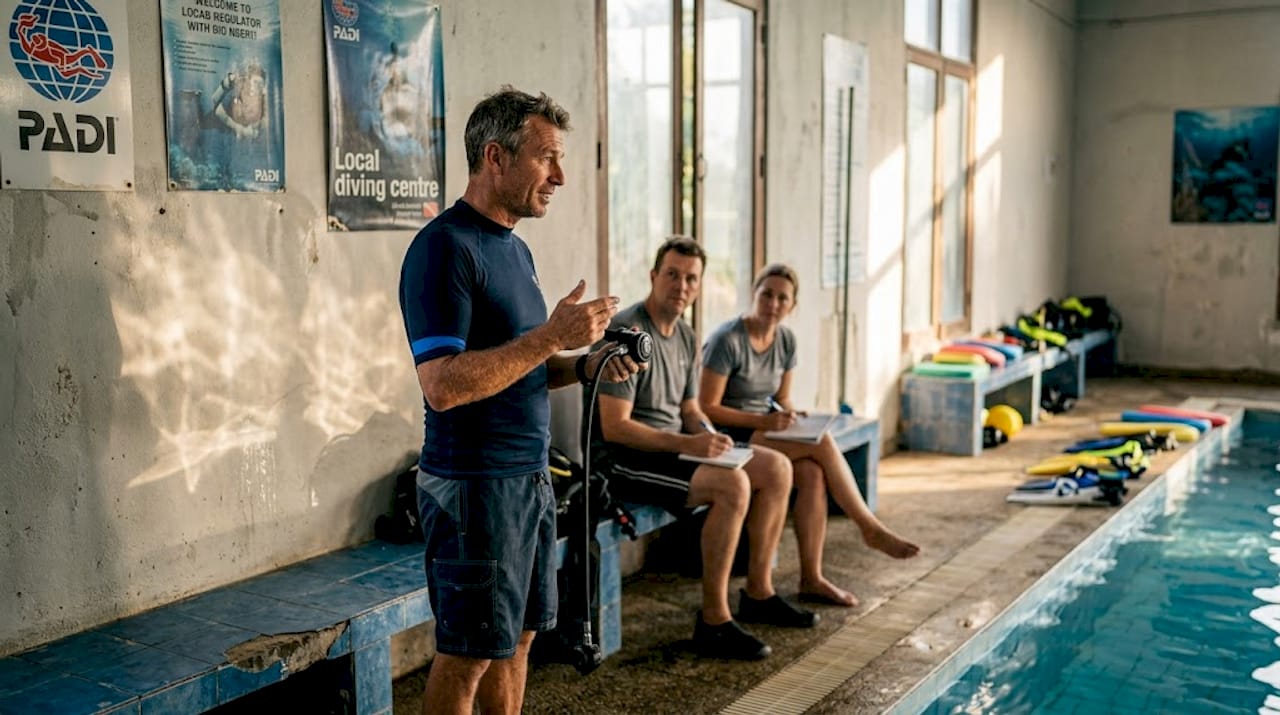
Standard pathway vs. referral pathway
| Factor | Standard pathway | Referral pathway |
|---|---|---|
| Location | Single dive centre | Split across two or more locations |
| Holiday time used | High (theory + pool + ocean) | Low (ocean dives only in Bali) |
| Flexibility | Fixed schedule | Fits around travel plans |
| Cost | All-in-one fee | Split between two centres |
| Dive conditions | Local pool or sea | World-class Bali reefs |
Pro Tip: Before leaving home, ask your instructor to use PADI’s official referral form and to sign and date every completed skill. Incomplete paperwork is the single most common cause of delays in Bali. Bringing a digital copy as a backup is a smart move.
Who should consider a referral dive for Bali?
If you’re planning a trip to Bali and have even a passing interest in diving, a referral pathway is worth serious consideration. It suits a surprisingly wide range of divers.
Referral dives offer unique advantages for travellers, including flexibility in timescales and the ability to spread learning across multiple locations. That flexibility is the key feature. Here’s who benefits most:
- Holiday-makers with limited time. If you have ten days in Bali, spending two in a classroom feels wasteful. A referral lets you arrive ready to dive.
- Busy professionals. Completing theory and pool work over several weekends at home is far easier than trying to squeeze a full course into a holiday.
- Families travelling together. Adults can knock out classroom sessions before the trip, freeing up family time in Bali for shared underwater adventures.
- Those who learn better when relaxed. Completing skills at home, without travel stress, often leads to more confident open water dives.
- Divers with specific site goals. If you’ve always dreamed of diving the USAT Liberty wreck in Tulamben or Amed’s dramatic slopes, a referral gets you there faster.
The numbers support this trend too. PADI’s global network has seen steady growth in referral completions as dive tourism expands across Southeast Asia. Bali is one of the world’s most visited dive resorts in Bali destinations, and tips for choosing a dive resort consistently highlight referral-friendliness as a key factor when selecting where to complete your training.
For anyone who wants to maximise their time in the water rather than at a desk, the referral route makes obvious sense. Bali’s underwater world is too extraordinary to spend your first days in a pool.
Referral dives in practice: Bali logistics and local tips
Deciding to use the referral route is the easy part. Making it work smoothly requires a little planning. Here’s how to get it right.
Key logistical steps:
- Contact your chosen Bali dive centre well before departure and confirm they accept referrals.
- Share your referral documentation digitally in advance so the instructor can review it.
- Confirm the number of open water dives required and whether a brief skills refresher is planned.
- Book your diving days early in your trip so you have flexibility if weather delays occur.
The referral system is widely accepted by reputable dive centres in popular destinations such as Bali, but ‘widely accepted’ doesn’t mean universal. Always confirm explicitly. Combining your certification completion with buddy diving benefits in Bali adds both safety and enjoyment to your open water dives.
Required documents for your referral dives
| Document | Purpose | Notes |
|---|---|---|
| PADI referral form | Confirms completed skills | Must be signed by original instructor |
| Medical statement | Confirms fitness to dive | Must be current and completed |
| Logbook | Records confined water dives | Keep all entries visible and legible |
| Photo ID or passport | Identity verification | Standard requirement |
| eLearning certificate | Confirms theory completion | Print or save digitally |
Pro Tip: Send scanned copies of all documents to your Bali dive centre at least a week before you arrive. This gives your instructor time to spot any gaps and advise you before you land. It’s one of the simplest ways to guarantee a smooth start. For broader context on planning your trip, our dive tourism in Bali guide covers conditions, seasons, and site highlights in detail.
Common mistakes to avoid: don’t assume your referral is still valid without checking. A PADI referral is typically valid for twelve months from completion of confined water training. Outdated paperwork means starting over, so check dates carefully before booking your flights.
Why referral dives are a game-changer for Bali-bound learners
Conventional wisdom says completing your entire PADI course in one place, with one instructor, is the safest and most consistent approach. Having worked with international clients at Bali Dive Cove over the years, we’d gently push back on that.
Students who arrive via referral often show stronger confidence in the water. They’ve had time to absorb theory without the pressure of an imminent dive. They’ve practised core skills in a familiar environment, so by the time they hit Amed’s reefs, the movements feel natural rather than new. The split approach builds a kind of layered readiness that one-location training sometimes rushes past.
There’s also the psychological effect of location. Completing your open water dives among Bali’s coral gardens, with warm water, good visibility, and no time pressure, creates a profoundly positive first diving memory. That matters. Divers who have a joyful certification experience are far more likely to continue diving. Explore our flexible dive course options and see how we support every stage of the referral pathway, from first contact to your final open water dive.
Start or complete your PADI certification in Bali
If you’re ready to finish your PADI certification in one of the world’s most breathtaking dive destinations, Bali Dive Cove is here to make it happen. Based in Amed, East Bali, we welcome referral students with open arms and a clear, unhurried approach.
Our experienced instructors have over 16 years of diving knowledge, covering Amed’s reefs, wrecks, and conditions in detail. Small groups mean you get genuine personal attention, not a rushed classroom experience. We offer PADI dive courses in Bali tailored to your schedule, as well as custom dive packages that combine certification dives with guided exploration of Bali’s best sites. Get in touch before your trip and we’ll help you plan every dive, from the paperwork to the plunge.
Frequently asked questions
How long is a PADI referral valid for?
A PADI referral is valid for 12 months from the completion of your initial confined water training, so plan your Bali trip within that window to avoid having to repeat any stages.
Do all Bali dive centres accept referrals?
Most reputable Bali dive centres accept referrals, as the referral system is widely accepted across popular dive destinations, but always confirm directly with your chosen centre before booking.
Can I switch from one certification agency to another with a referral?
Transfers between agencies are possible at many dive centres, but you should verify that your chosen Bali facility supports your original training organisation before travelling.
What documents do I need to bring for my referral dives?
Proper documentation is essential, so bring your signed referral form, completed medical statement, logbook, photo identification, and your eLearning completion certificate to the Bali dive centre.
