


Every family wants their first underwater adventure to feel safe, personal, and memorable. Planning a diving holiday in Bali brings excitement, but first-time divers often feel unsure about preparing the right paperwork and checking gear. For families looking to enjoy relaxed, guided exploration with trusted PADI instructors, preparing essential documentation and understanding proper safety steps set the stage for an unforgettable experience in Bali’s warm waters.
Table of Contents
- Step 1: Gather Essential Dive Documentation
- Step 2: Select and Inspect Dive Gear
- Step 3: Review Dive Site Safety Protocols
- Step 4: Conduct Final Pre-Dive Equipment Checks
- Step 5: Confirm Personal Readiness and Dive Plan
Quick Summary
| Key Point | Explanation |
|---|---|
| 1. Gather Essential Dive Documents | Collect certification, medical clearance, and permits to ensure compliance and safety for your dive in Bali. |
| 2. Ensure Proper Dive Gear Selection | Choose rental gear suited for Bali’s warm waters and conduct thorough inspections to confirm functionality before diving. |
| 3. Review Dive Site Safety Protocols | Familiarise yourself with specific site boundaries, hazards, and emergency procedures to stay safe during your dive. |
| 4. Conduct Final Equipment Checks | Confirm all gear functions correctly and perform a buddy check to ensure readiness and address any issues before diving. |
| 5. Assess Personal Readiness and Dive Plan | Evaluate your physical and emotional state, review dive details with your instructor, and mentally prepare to build confidence before entry. |
Step 1: Gather Essential Dive Documentation
Before you pack your fins, you need to collect the right paperwork. Think of documentation as your passport to a safe, legally compliant dive experience in Bali. This step ensures you’re prepared, protected, and ready to enjoy the water without last-minute stress.
Start by securing your certification card. Whether you’re a beginner taking your first PADI course or arriving with existing certifications, dive resorts require proof of training. Your card shows your qualification level and the skills you’ve mastered underwater. Keep it somewhere dry and accessible, not buried in luggage.
Next, gather your medical clearance. Before diving, especially in warm water environments, many resorts ask for documentation confirming you’re physically fit for diving. This aligns with institutional best practices where recreational dive centers require medical clearances before equipment rental or participation. Your doctor can complete a simple form stating you have no cardiovascular, respiratory, or other conditions that would make diving unsafe.
Collect the following documents:
Here’s a summary comparing key dive documents and what each provides:
| Document Type | Purpose | Who Requires It |
|---|---|---|
| Certification Card | Proves your dive training | All dive operators |
| Medical Clearance | Confirms diving fitness | Resorts, rental centers |
| Dive Permit | Legal access to certain sites | Protected area officials |
| Emergency Contact Info | Ensures quick emergency action | Dive shop and guides |
| Travel Insurance | Covers accidents/illnesses | Not always mandatory |
- Your valid passport (copy and original)
- Travel insurance documents
- Emergency contact information
- Any prescription medications with original labels
- A completed liability waiver (most resorts provide this)
Bring dive permits if required by your destination or dive operator. Some sites, especially protected marine areas, require advance permits. Bali Dive Cove can advise on specific requirements for East Bali dive sites during your initial booking.
Verify that essential pre-dive documentation includes your certification records and any recent dive logs. Having this information organised shows professionalism and keeps your dives on schedule. Digital copies stored in your phone or cloud storage provide a backup if physical documents get damaged.
Keep all documents in a waterproof bag or dry case, and make copies of everything. One copy stays in your accommodation, one travels with you, and one stays at home.
Pro tip: Email scanned copies of your certifications and medical clearance to your dive resort before arriving. This speeds up check-in and gives them time to flag any questions so you can resolve them instantly rather than on dive day.
Step 2: Select and Inspect Dive Gear
Equipment is your lifeline underwater, so choosing the right gear and inspecting it properly makes all the difference. This step ensures your setup fits well, functions perfectly, and matches the conditions you’ll encounter in Bali’s warm waters.
Start by understanding what you need. Basic dive gear includes a wetsuit, buoyancy compensator (BCD), regulator, dive computer, mask, fins, and tank. Many beginners rent equipment from their resort rather than buying, which makes sense for a first trip. Bali Dive Cove provides well-maintained rental gear suitable for East Bali’s reefs and wrecks.
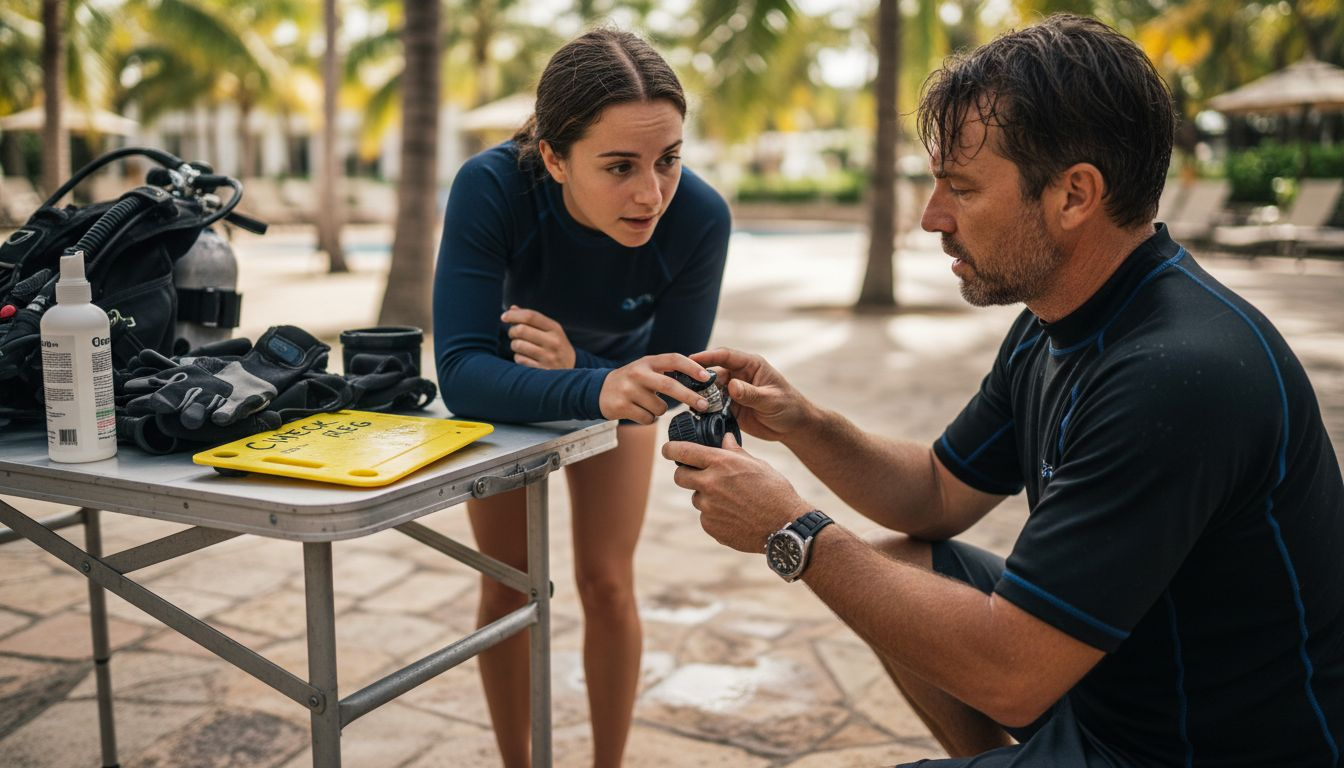
When selecting your wetsuit, consider thickness and fit. Bali’s water stays warm year-round, typically between 26 to 30 degrees Celsius, so a 3-millimeter suit offers adequate protection while allowing mobility. Your suit should feel snug but not restrictive, like a second skin that doesn’t cut off circulation.
Before entering the water, conduct a thorough inspection. Equipment inspection before diving is mandatory for safe operations. Check these essential items:
- Your BCD inflates and deflates smoothly without leaks
- The regulator delivers air consistently when you breathe
- Your dive computer displays correctly and holds a charge
- The mask seals properly around your face without gaps
- Fins fit snugly but allow wiggle room for your toes
- Tank valve opens and closes freely
Look for visible damage or wear on all equipment. Cracks in the mask, loose straps, corroded metal parts, or hoses with splits mean that gear needs repair or replacement. Don’t overlook small issues, as they often become big problems at depth.
Test your gear assembly at the surface. Breathe from your regulator, press your BCD inflator button, and confirm everything responds as expected. Your instructor will guide you through this before every dive.
Equipment that feels wrong before the dive will feel worse at 40 feet. Trust your instincts and speak up immediately.
Pro tip: Arrive at your dive resort at least one day early to try on rental gear and adjust it properly. This eliminates surprises on dive day and gives you time to request different sizes if needed.
This table highlights key differences between rental and personal dive gear use:
| Aspect | Rental Gear in Bali | Personal Gear |
|---|---|---|
| Fit Adjustment | May require on-site tweaks | Pre-adjusted to diver |
| Maintenance | Handled by resort staff | Diver’s own responsibility |
| Hygiene Control | Cleaned by staff, shared use | Full personal hygiene |
| Cost/Effort | Included in dive package | Requires travel, packing |
Step 3: Review Dive Site Safety Protocols
Every dive site has its own personality, hazards, and safety considerations. Understanding these protocols before you enter the water keeps you prepared and confident. This step ensures you know what to expect and how to respond to site-specific conditions.
Start by learning about your specific dive site. Bali Dive Cove operates primarily in East Bali, where sites like the USAT Liberty wreck and vibrant coral reefs each present unique challenges. Ask your instructor about water visibility, current strength, depth, marine life encounters, and any underwater obstacles. Sites change seasonally, so recent information matters more than what you read online months ago.
Understand the dive site boundaries before you go down. Your instructor will explain how far you can explore and what areas are off-limits. These boundaries exist for safety reasons. Proper dive site safety protocols establish clear operational limits and communication procedures so everyone stays together and knows what to do in emergencies.
Know the emergency procedures specific to your site. Ask these critical questions:
- Where is the emergency exit or ascent point?
- What should you do if separated from your buddy?
- How do you signal distress underwater?
- Are there hazards like strong currents or surge?
- What marine life should you avoid or be cautious around?
Review communication signals with your instructor and dive buddy. Underwater, you cannot talk, so hand signals become your language. Standard signals include “OK,” “not OK,” “go up,” and “go down.” Practice these signals at the surface before every dive so they feel automatic.
Check the weather and water conditions on dive day. Strong currents, poor visibility, or rough seas might mean your site gets changed for safety. This is not a disappointment but a smart precaution. Your instructors monitor conditions constantly and adjust plans to keep everyone safe.
Safety protocols exist because experience taught the diving community hard lessons. Following them is not overcautious; it is respectful to those who came before.
Pro tip: Request a detailed site briefing the evening before your dive so you have time to process information and ask questions. This calm, unhurried approach beats rushing through a briefing minutes before entering the water.
Step 4: Conduct Final Pre-Dive Equipment Checks
You’re moments away from entering the water. This final check separates divers who dive safely from those who take unnecessary risks. Running through a systematic equipment inspection on the boat or beach ensures nothing is overlooked and everything functions perfectly.
Start with your air supply. Check that your tank is full by reading the pressure gauge. A full tank typically reads between 200 and 210 bar (about 3000 PSI). Ask your instructor or dive master to confirm the reading if you’re unsure. Never proceed with a partially filled tank unless explicitly approved for your specific dive profile.
Test your regulator by taking a few breaths at the surface. Air should flow smoothly when you inhale and stop when you exhale. Listen for any unusual sounds or hissing. Check both your primary regulator and your alternate (backup) regulator to ensure both deliver air consistently.
Verify your buoyancy compensator one final time. Inflate it fully at the surface and confirm it holds air without leaking. Deflate it completely and check the dump valves respond properly. Your BCD is your tool for controlling your depth underwater, so this check matters tremendously.
Perform comprehensive pre-dive equipment checks including these final items:
- Mask and fins fit snugly without discomfort
- Wetsuit sits properly without restricting movement
- Dive computer powers on and displays correctly
- Weight belt or integrated weights are secure
- All straps and fasteners are tight and secure
- Your buddy check is complete and confirmed
Perform the buddy check with your dive partner. This systematic review confirms both of you are ready. You’ll check each other’s equipment, confirm signals, and establish how you’ll stay together. Never skip this step, even if you’ve dived with your buddy before.
Take a moment to breathe deeply and center yourself. Diving is safer when you’re calm and focused. If anything feels wrong or you have doubts, speak up immediately. Your instructor wants you to voice concerns; there is no such thing as a silly question at this stage.
A two-minute equipment check on the surface prevents emergencies at depth. Thorough preparation is how you stay safe.
Pro tip: Create a personal checklist using your fingers to count through items. As you touch your mask, regulator, BCD, weights, and buddy, mentally confirm each is ready. This tactile approach helps your brain lock in the sequence.
Step 5: Confirm Personal Readiness and Dive Plan
Before you enter the water, take a moment to verify you are physically and mentally ready. This step involves honest self-assessment and understanding exactly what you will experience on this dive. Preparation transforms nervousness into confidence.
Assess your physical fitness for diving today. Ask yourself if you are well-rested, hydrated, and free from illness or injury. Avoid diving if you have a cold, ear infection, or sinus congestion, as pressure changes underwater can cause serious discomfort or injury. If you took medication recently, ask your instructor whether it affects your diving ability.
Confirm your medical clearance is current. Before diving, verifying diver medical fitness ensures you are physically capable of handling the underwater environment. If you have any health conditions, cardiac issues, or respiratory concerns, disclose them to your instructor now, not after you are geared up.
Review your dive profile and objectives with your instructor. Understand these critical details:
- Maximum depth you will reach
- Expected bottom time
- Where you will descend and ascend
- What you will see or do underwater
- Any special skills you will practice
- Emergency procedures specific to this dive
Confirm the dive plan with your buddy and instructor. Everyone on the dive team must understand the objectives, safety procedures, and emergency communications. Your instructor will brief all divers together and answer questions before entering the water. This is not a moment to stay quiet if something is unclear.
Mentally rehearse the dive. Visualise descending, exploring the site, and ascending. Imagine yourself staying calm and using the skills you practiced. Mental preparation reduces anxiety and helps your body respond smoothly when you are underwater.
Evaluate your emotional state. Nervousness is normal for beginners; fear is not. If you feel genuine fear rather than anticipation, speak with your instructor. They can address your concerns, adjust the dive plan, or suggest postponing until you feel more confident. There is no shame in this choice.
You are ready when your mind, body, and heart align. Trust that feeling.
Pro tip: Write down the dive plan details after the briefing, or take a photo of the briefing board. Reviewing these notes while sitting on the boat anchors the information and calms pre-dive jitters.
Prepare to Dive Confidently with Bali Dive Cove
Scuba diving preparation can feel overwhelming for beginners, especially when managing dive documentation, gear inspection, and safety protocols as explained in the article “Scuba Diving Preparation Workflow for Beginners in Bali”. You want to feel safe, supported, and ready to explore Bali’s incredible underwater world without second-guessing your readiness or equipment. At Bali Dive Cove, we eliminate these worries by guiding you through every step with our experienced instructors who focus on clear communication and personalised attention.
Start your diving journey with trusted experts who understand the challenges of dive preparation firsthand. Whether confirming your certification, conducting thorough equipment checks, or reviewing dive site safety protocols, our family-owned PADI 5-Star Dive Resort in East Bali offers small group guided dives and PADI courses that make your experience relaxed and enjoyable. Take the next step toward confident diving by visiting Bali Dive Cove and discover how we prepare you thoroughly with dive courses and guided dives. Don’t wait to transform your nervousness into calm excitement. Book now and dive into adventure safely and confidently.
Frequently Asked Questions
What essential documents do I need to gather before diving in Bali?
You should collect your certification card, medical clearance, and travel insurance documents. Also, bring your dive permit if required, emergency contact info, and weights, which can ensure a smooth and safe diving experience.
How do I choose the right dive gear for my trip?
Select basic gear such as a wetsuit, buoyancy compensator (BCD), and regulator, appropriate for Bali’s warm waters. For beginners, renting equipment from your dive resort is often the most practical option during your first trip, which allows you to adjust sizes as needed.
What safety protocols should I review for my dive site?
Before diving, familiarize yourself with the dive site’s boundaries and emergency procedures. Discuss with your instructor any specific hazards, such as currents or underwater obstacles, to ensure you’re aware and can perform safely underwater.
How do I perform final pre-dive equipment checks?
Conduct a systematic final check of your gear just before entering the water. Check your air supply, ensure your regulator works properly, and confirm that your buoyancy compensator holds air without leaking to avoid unnecessary risks during the dive.
How can I confirm my personal readiness for diving?
Assess your physical and emotional state by ensuring you are well-rested, hydrated, and free of illness before diving. If you have any concerns or doubts, discuss them with your instructor to determine if you are ready to dive today or if adjustments are needed.
What should I do if I feel nervous or fearful before my dive?
It’s normal to feel nervous as a beginner, but if you feel genuine fear, speak with your instructor. They can help you address your concerns or adjust the dive plan to boost your confidence, helping you enjoy the experience more fully.
