

TL;DR:
- Bali’s saltwater and tropical environment accelerate scuba gear corrosion and material degradation.
- Proper post-dive rinsing and storage are crucial to prevent safety risks and extend gear lifespan.
- Regular inspections and correct storage habits ensure equipment remains safe and reliable for every dive.
Bali’s warm, salty waters are a paradise for divers, but they are quietly unforgiving on your equipment. Salt corrosion, tropical humidity, and relentless UV exposure can degrade a regulator, BCD, or wetsuit far faster than you might expect. A single neglected rinse after a dive on Amed’s reefs can set off a chain of rust, bacterial growth, and mechanical failure that shortens your gear’s life and, more importantly, puts your safety at risk. Whether you’re a first-time diver or a seasoned underwater explorer, these practical maintenance tips will help you keep your kit reliable, safe, and ready for every dive Bali has to offer.
Key Takeaways
| Point | Details |
|---|---|
| Immediate rinsing is vital | Saltwater dries quickly in Bali’s heat, so rinse all gear with fresh water as soon as possible after your dive. |
| Annual tank inspections | Keep your air tanks safe and compliant with an annual visual check and a five-year hydrostatic test. |
| Proper storage prevents damage | Store gear in cool, dry, ventilated spaces to prevent mildew, corrosion, and mechanical stress. |
| Routine care builds confidence | Consistently maintaining your scuba gear ensures safety and peace of mind for every Bali adventure. |
Understand Bali’s environment and its impact on scuba gear
Bali is not your average dive destination. The island sits in a tropical zone where water temperatures hover between 26°C and 30°C, humidity rarely drops below 70%, and the ocean carries a high salt content. These conditions create a perfect storm for gear degradation. Understanding exactly what your equipment faces here is the first step to protecting it.
Salt is the biggest culprit. When saltwater dries on metal components, rubber seals, and fabric, it leaves behind crystalline deposits that eat into surfaces and cause corrosion. On a regulator’s first stage, for example, salt build-up can compromise the internal valves that control your air supply. On a BCD’s inflator mechanism, it can cause the button to stick or fail. This is not a slow process either. In Bali’s heat, salt dries fast, promoting rapid corrosion that can begin within hours of your dive ending.
Beyond salt, Bali’s environment throws several other threats at your gear:
- UV exposure: Intense tropical sunlight breaks down neoprene and rubber over time, making wetsuits and hoses brittle and prone to cracking.
- Sand and sediment: Amed’s volcanic black sand is particularly fine and abrasive. It works its way into zips, buckles, and regulator ports with ease.
- High humidity: Even when your gear is stored, Bali’s humidity encourages mildew growth inside wetsuits and BCD bladders, creating unpleasant smells and weakening materials.
- Warm water: Heat accelerates the breakdown of O-rings and rubber seals, which are critical to keeping your air supply and buoyancy system working correctly.
“In Bali’s tropical climate and high salinity, prioritise immediate rinsing post-dive as salt dries fast, promoting rapid corrosion.”
The consequences of ignoring these threats go beyond inconvenience. A sticky BCD inflator or a corroded regulator valve is not just annoying, it is a genuine safety risk underwater. Before every dive, running through a solid pre-dive safety checklist helps you catch any early warning signs before they become problems. Equally, being mindful of dive site etiquette means you’ll handle your gear with care around Bali’s fragile reefs, reducing the chance of accidental damage from contact with coral or rock.
Essential post-dive rinsing and cleaning routine
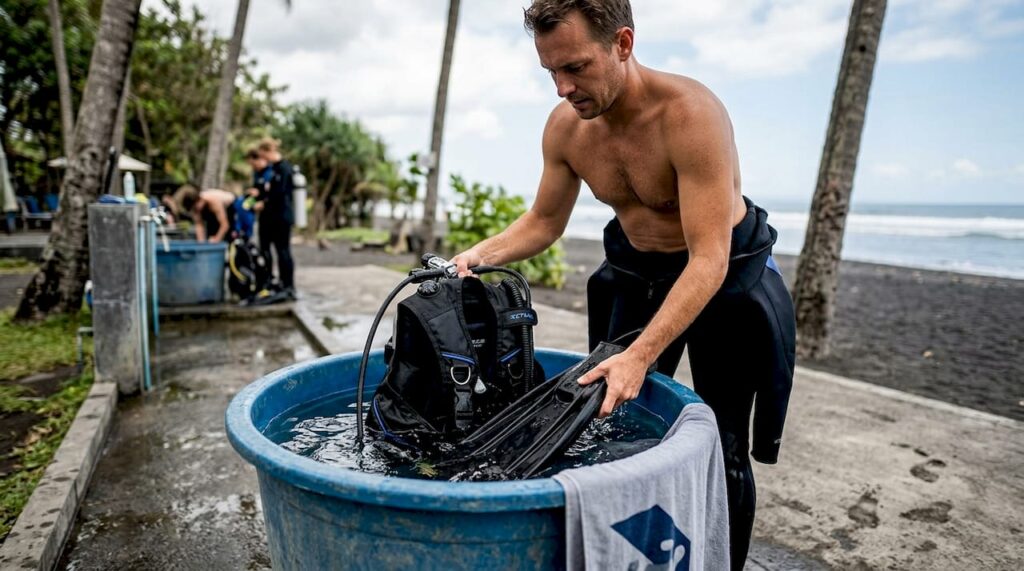
Understanding why thorough rinsing matters, here’s how to do it right after every Bali dive. The good news is that a proper rinse routine does not take long. Done consistently, it adds only a few minutes to your post-dive wind-down and makes an enormous difference to how long your gear lasts.
Rinse all scuba gear thoroughly with fresh water after every dive, especially critical in Bali’s warm saltwater. Here is a step-by-step approach to make sure nothing gets missed:
- Regulators: Before rinsing, secure the dust cap firmly over the first stage inlet. This prevents water from entering the high-pressure port. Submerge the regulator in fresh water and press the purge button gently to flush the second stage. Do not press the purge button on the first stage while the dust cap is off.
- BCD: Rinse the outside thoroughly, paying close attention to buckles, clips, and the inflator mechanism. Then add a small amount of fresh water through the oral inflator, slosh it around inside the bladder, and drain it out. This flushes salt and bacteria from the interior.
- Wetsuit: Turn it inside out and rinse both surfaces well. The inside of a wetsuit traps body oils, bacteria, and salt, and skipping this step leads to that familiar unpleasant smell after just a few uses.
- Mask and fins: Rinse both in fresh water, making sure to clear sand from the fin foot pockets and the mask skirt.
- Dive computer and torch: Wipe down and rinse these carefully, checking that any battery compartment seals are intact before submerging.
Most dive resorts in Amed and across Bali provide rinse tubs near the water’s edge. Use them immediately after surfacing rather than waiting until you return to your accommodation. The longer salt sits on your gear, the harder it works.
Pro Tip: Keep a soft-bristled brush in your dive bag. It is invaluable for working salt and sand out of buckles, zip teeth, and the crevices around regulator ports where a simple rinse cannot reach.
Even after a short shore dive or a quick skills session, never skip the rinse. Incorporating this into your dive preparation workflow as a non-negotiable step before and after every dive will save you significant repair costs down the line.
Annual inspections and tank care: what every diver must check
With cleaning covered, proper inspection and tank care are your next line of defence. Your tank is the most safety-critical piece of equipment you own, and it has legally required inspection intervals that every diver should know.
| Inspection type | Frequency | What is checked |
|---|---|---|
| Visual inspection | Annually | Interior corrosion, valve condition, thread integrity, exterior damage |
| Hydrostatic test | Every 5 years | Tank wall integrity, pressure tolerance, structural soundness |
Annual visual inspection and hydrostatic testing every five years are the minimum standards for tank safety. A qualified technician will examine the interior for rust, pitting, or contamination, and check that the valve is functioning correctly. Between official inspections, there are warning signs you can watch for yourself:
- Discolouration or rust streaks on the exterior, particularly around the valve
- A damp or musty smell when you crack the valve open
- Visible dents, gouges, or deep scratches on the cylinder body
- A valve that feels stiff, sticky, or inconsistent when turned
- Any hissing sound when the tank is pressurised and the valve is closed
For day-to-day tank care, always rinse the exterior after diving and store tanks upright in a cool, dry location. Never store a tank completely empty. Leaving a small amount of air inside prevents moisture from entering and causing internal corrosion. Avoid laying tanks on their sides where they can roll and sustain impact damage.
Pro Tip: Record every inspection date, the technician’s name, and the result in your dive log. If you’re diving with rental tanks in Bali, it’s perfectly reasonable to ask the dive operator when their tanks were last inspected. A reputable operator will always have this information ready. If you spot any concerns, refer to our guide on troubleshooting dive issues for practical next steps.
Storing your scuba gear: top practices for humid Bali conditions
Once your gear is clean and checked, here’s how to keep it in top shape between your next adventures. Storage might seem like a minor detail, but in Bali’s humid climate, poor storage habits undo all the good work of a thorough rinse.
Here are the key do’s and don’ts for storing scuba gear in Bali:
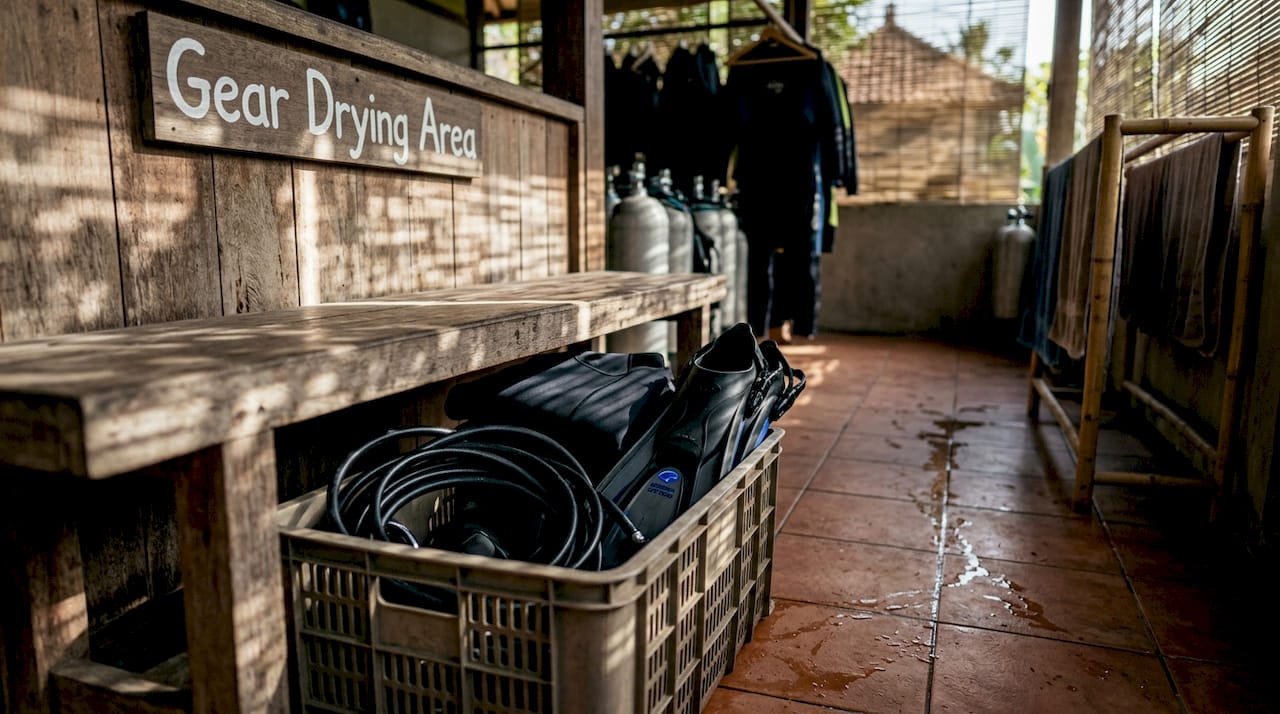
- Do store gear in a cool, shaded, and well-ventilated space away from direct sunlight
- Do hang wetsuits on wide, padded hangers to maintain their shape
- Do coil hoses loosely without tight bends that stress the rubber
- Don’t leave gear in a sealed bag or car boot where heat and humidity build up
- Don’t store gear near chemicals, petrol, or cleaning products that can degrade rubber
- Don’t compress or fold BCDs for long periods, as this can damage the bladder
Cool, dry, shaded, and ventilated storage with no compression and loose hose coils is the gold standard. The comparison below shows just how much the environment matters:
| Storage condition | Effect on gear |
|---|---|
| Direct sunlight | Breaks down neoprene, fades colours, degrades rubber seals |
| Sealed bag or case | Traps moisture, promotes mildew and bacterial growth |
| Cool, ventilated space | Preserves materials, prevents mildew, extends gear lifespan |
| Tightly coiled hoses | Creates stress fractures in rubber over time |
| Loosely hung, open storage | Maintains shape, allows drying, reduces wear |
For travelling divers moving between Bali’s dive areas, give your gear at least a few hours to air-dry before packing it. If you’re staying in Amed for several days, ask your accommodation whether there’s a shaded outdoor area or gear rack you can use. Many dive resorts offer this as standard. Connecting with the wider Bali dive community is also a great way to pick up local storage tips from divers who know Bali’s conditions well.
A diver’s perspective: the real-world value of disciplined maintenance
After years of guiding divers around Amed’s reefs and wrecks, one pattern stands out clearly. Nearly every equipment problem we encounter on a dive traces back to a skipped rinse, a rushed storage job, or an overdue inspection. It rarely comes down to bad luck.
Bali’s dive days move fast. You surface from a beautiful dive on the USAT Liberty wreck in Tulamben, someone suggests a second dive, and suddenly the rinse tub feels like an inconvenient detour. We understand that feeling completely. But those small shortcuts accumulate. A sticky inflator button on dive three of your holiday is not random. It is the result of salt build-up that a two-minute rinse would have prevented.
What we’ve also seen is that divers who maintain disciplined pre-dive habits and post-dive routines are noticeably more relaxed underwater. When you trust your gear completely, you can focus on the manta rays, the nudibranchs, and the vibrant coral gardens rather than second-guessing your equipment. Maintenance is not just a chore. It is the foundation of confidence on every dive.
Enhance your Bali dive experience with expert support
Knowing how to care for your gear is one thing. Putting it into practice alongside experienced guides who share the same standards is another level entirely.
At Bali Dive Cove, we build gear awareness into every dive we lead. Whether you’re joining one of our Bali dive packages for a guided reef or wreck experience, working through Bali dive courses towards your next PADI certification, or exploring our range of Bali dive sites, our instructors are always on hand to answer questions about gear care, safety checks, and best practice. Small groups, unhurried dives, and genuine personal attention. That’s what we offer every diver who joins us in Amed.
Frequently asked questions
How soon should I rinse my gear after a Bali dive?
Rinse your gear immediately after every Bali dive with fresh water. Salt dries quickly in Bali’s tropical heat, accelerating corrosion and bacterial growth on all equipment surfaces.
What’s the best way to store my scuba gear in Bali hotels or resorts?
Store your gear in a cool, dry, shaded, and ventilated space. Avoid direct sunlight and compressed bags, and always coil hoses loosely to prevent stress fractures in the rubber.
How often should I inspect my tanks and gear?
Your tanks require an annual visual inspection and a hydrostatic pressure test every five years, carried out by a qualified technician to confirm structural integrity.
Are resort rinse tubs enough for proper post-dive cleaning?
Resort rinse tubs are a helpful first step, but always follow up with a thorough fresh water rinse to remove all remaining salt and sand from every piece of your equipment.
