

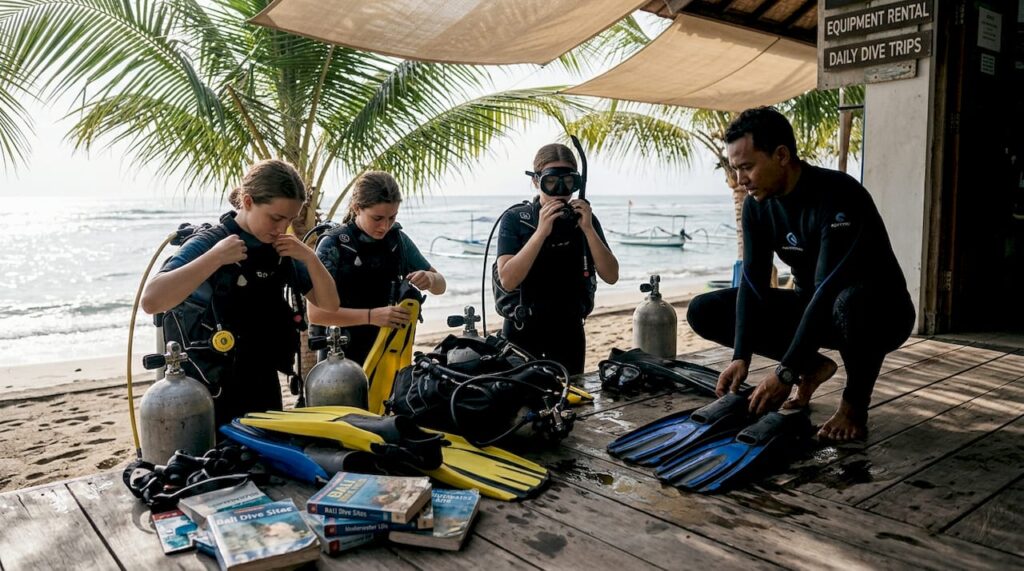
Many people believe scuba diving is reserved for expert swimmers or seasoned adventurers. This misconception keeps curious travellers from experiencing one of Bali’s most accessible and rewarding activities. Anyone with basic health and a sense of adventure can explore underwater worlds with proper instruction and equipment. This guide explains what scuba diving involves, the types of dives available in Bali, how to get certified, and essential safety practices to help you confidently plan your underwater adventure.
Key Takeaways
| Point | Details |
|---|---|
| Accessibility for beginners | Scuba diving in Bali is accessible to most people with basic health and proper instruction, enabling novices to start under supervision. |
| Essential equipment | Basic gear includes a mask, regulator, fins, buoyancy control device, a wetsuit, weights and instruments to monitor depth and air supply. |
| Beginner supervision | Professional supervision ensures beginners dive safely, with instructors staying close and adjusting the pace as skills develop. |
| Bali dive types | Bali offers recreational, deep, wreck, night and speciality dives with opportunities for underwater photography and drift experiences. |
Understanding scuba diving: what it involves and who can do it
Scuba diving allows you to breathe underwater using specialised equipment whilst exploring marine environments. The acronym stands for Self-Contained Underwater Breathing Apparatus. A compressed air tank worn on your back delivers breathable air through a regulator mouthpiece, enabling you to stay submerged for extended periods. This system gives you freedom to move naturally underwater whilst maintaining a constant air supply.
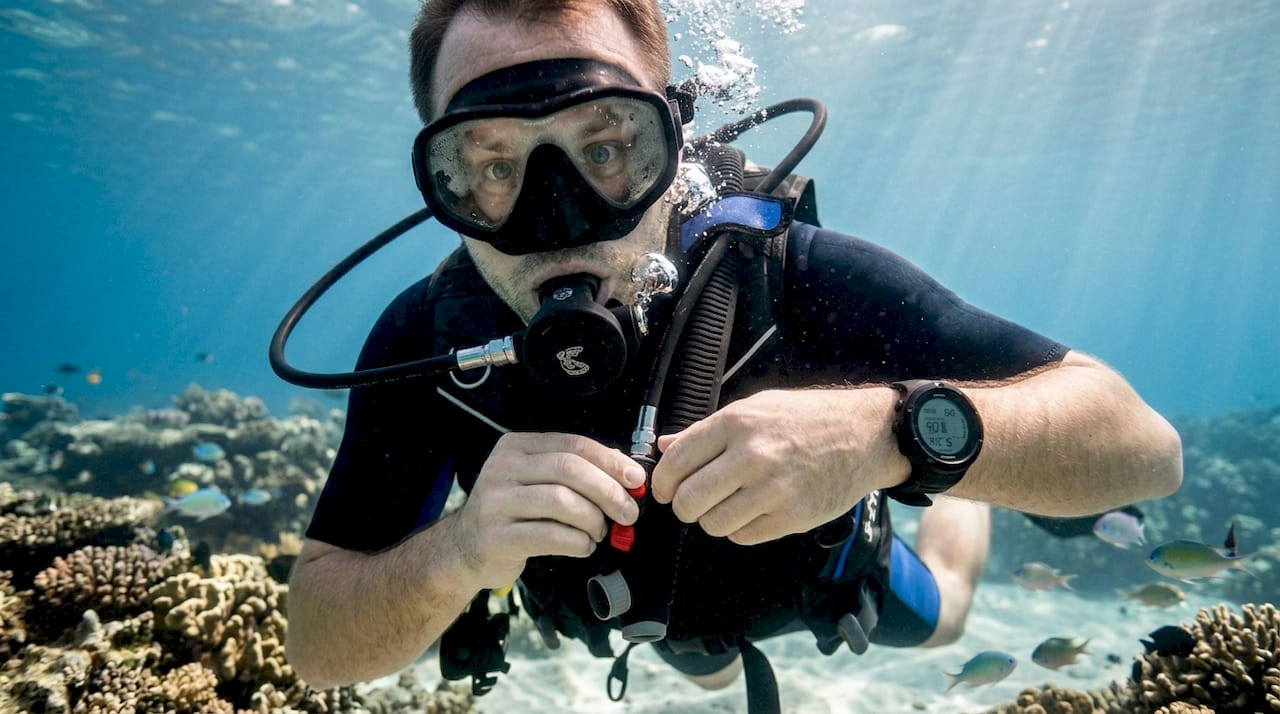
Essential equipment includes several interconnected components. Your mask creates an air pocket around your eyes for clear vision underwater. The regulator reduces high-pressure tank air to breathable levels and delivers it on demand. Fins provide efficient propulsion with minimal effort. A buoyancy control device allows you to adjust your depth and hover weightlessly. Additional gear includes a wetsuit for warmth, weights for proper buoyancy, and instruments to monitor depth and air supply.
Beginner courses teach fundamental skills in controlled environments before open water dives. You learn to clear water from your mask, recover your regulator if it comes loose, control your buoyancy, and communicate underwater using hand signals. Instructors demonstrate each skill multiple times and provide individual attention until you perform them confidently. These techniques become second nature with practice.
Scuba diving can be accessible to novices with proper instruction and equipment. Most people aged 10 and above can participate if they meet basic health requirements. You need reasonable fitness but not athletic ability. Medical conditions affecting breathing, heart function, or pressure equalisation may require physician clearance. Swimming ability helps but many non-swimmers successfully complete courses after building water confidence with instructors.
Professional supervision ensures beginners dive safely from their first breath underwater. Instructors maintain close proximity, monitor your comfort level, and adjust the pace to match your learning speed. Initial dives occur in shallow, calm water where you can stand if needed. This gradual approach builds confidence whilst developing essential skills.
Pro tip: Practice breathing slowly and deeply through your mouth before your first dive. This simple exercise helps you adapt to regulator breathing and reduces initial anxiety underwater.
Types of scuba diving and popular Bali dive experiences
Scuba diving encompasses various specialised categories, each offering unique underwater experiences. Recreational diving represents the most common type, focusing on enjoyment and exploration within safe depth limits. Deep diving extends beyond standard recreational depths to explore features like walls and deeper wrecks. Wreck diving involves exploring sunken vessels and artificial reef structures. Night diving reveals nocturnal marine life and different reef behaviours after dark. Speciality dives include underwater photography, marine biology observation, and drift diving with ocean currents.
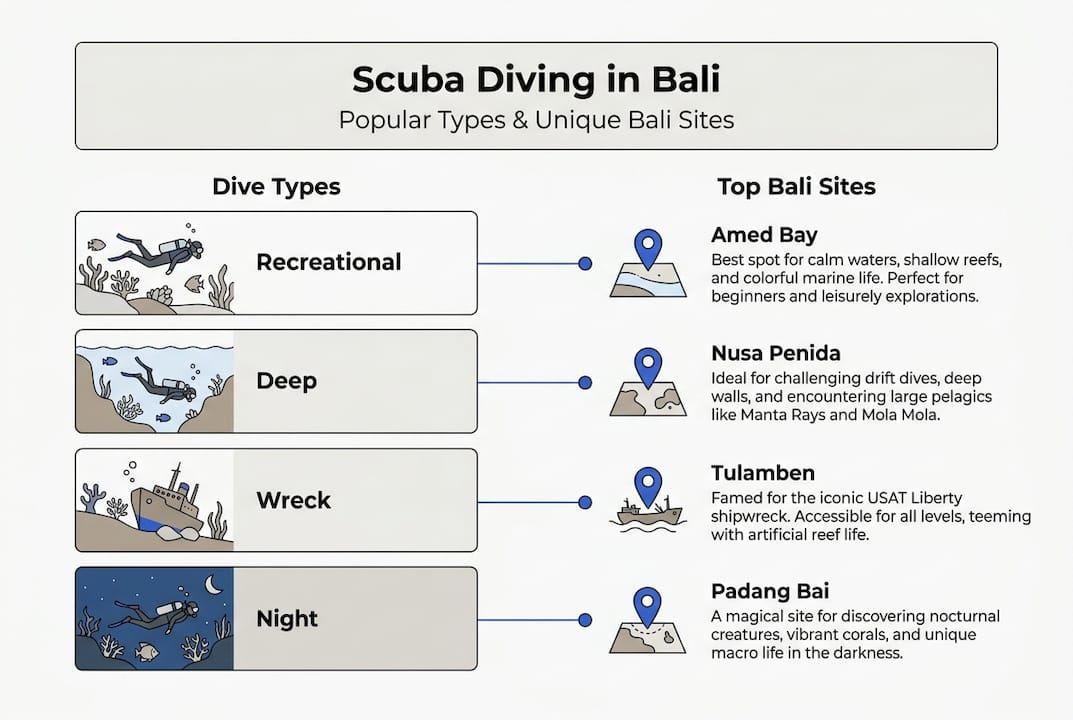
Recreational diving suits beginners and forms the foundation for other dive types. You explore coral reefs, swim alongside tropical fish, and discover underwater landscapes at depths typically between 5 and 18 metres. These dives prioritise safety, comfort, and marine life observation. Most Bali coastal sites offer excellent recreational diving with vibrant coral gardens and diverse species.
Deep diving requires advanced certification and takes you between 18 and 40 metres. Deeper sites often harbour larger marine animals, dramatic topography, and features invisible from shallower depths. Nitrogen absorption increases with depth, requiring careful dive planning and shorter bottom times. Experienced divers appreciate the unique ecosystems and geological formations found deeper.
Wreck diving combines history with marine exploration. Bali offers diverse dive types, including wreck and night diving. The Japanese shipwreck in Amed provides an iconic wreck dive accessible to intermediate divers. The vessel rests between 6 and 30 metres, allowing exploration at various skill levels. Marine growth covers the structure, creating artificial reef habitat for countless species.
Night diving transforms familiar sites into different worlds. Nocturnal creatures emerge whilst daytime species sleep. Bioluminescent plankton may sparkle around your movements. Torch beams reveal colours invisible in natural daylight due to water’s light-filtering properties. Night dives require good buoyancy control and comfort with navigation.
| Dive type | Difficulty level | Depth range | Popular Bali sites | Best for |
|---|---|---|---|---|
| Recreational | Beginner to intermediate | 5-18 metres | Jemeluk Bay, Coral Garden | First-time divers, marine life viewing |
| Wreck | Intermediate to advanced | 6-30 metres | Japanese Shipwreck, USAT Liberty | History enthusiasts, photographers |
| Night | Intermediate | 5-15 metres | Jemeluk Bay, Drop Off | Observing nocturnal species |
| Deep | Advanced | 18-40 metres | The Drop Off, Deep Reef | Experienced divers seeking unique topography |
| Drift | Intermediate to advanced | 10-30 metres | Gili Selang, Gili Mimpang | Efficiency, large pelagic sightings |
Bali’s geographical diversity creates varied underwater environments. East Bali sites around Amed feature calm bays, dramatic walls, and accessible wrecks. Current-swept channels attract large pelagic species. North Bali offers different reef structures and marine life. This variety means you can experience multiple types of scuba diving in Bali during a single trip. Operators match Bali dive sites to your certification level and interests.
Getting started with scuba diving in Bali: courses and certifications
Beginning your scuba journey involves structured training that builds skills progressively. The entry-level PADI Open Water Diver course follows a proven three-phase approach. Phase one covers dive theory through online learning or classroom sessions. You study physics principles affecting divers, safety procedures, equipment function, and dive planning fundamentals. This knowledge foundation prepares you for practical training.
Phase two involves confined water training, typically in a swimming pool or shallow, protected bay. Here you practice essential skills in a controlled environment where you can stand. You learn to assemble equipment, achieve neutral buoyancy, clear your mask underwater, and respond to simulated problems. Instructors demonstrate each skill, then supervise your practice until you perform it confidently. This phase usually requires four to six sessions.
Phase three consists of four open water training dives at actual dive sites. You apply classroom knowledge and confined water skills in real diving conditions. Each dive introduces new elements whilst reinforcing previous learning. Depths gradually increase from shallow orientations to 18 metres maximum. Upon successful completion, you receive certification valid worldwide with no expiration.
PADI certifications are the standard for learning scuba diving safely and progressively. The system offers clear advancement pathways. After Open Water certification, you can pursue Advanced Open Water, which includes five specialty dives exploring different aspects like navigation, deep diving, and wreck diving. This certification expands your capabilities and dive site access.
Speciality courses focus on specific skills or environments:
- Deep Diver certification qualifies you for dives between 18 and 40 metres, opening access to deeper wrecks and walls
- Wreck Diver training teaches safe wreck penetration techniques and historical preservation practices
- Night Diver certification develops skills for diving after dark with proper lighting and navigation
- Underwater Photography courses improve your ability to capture marine life whilst maintaining buoyancy and awareness
- Nitrox certification allows use of enriched air mixtures for longer bottom times and shorter surface intervals
Choosing the right course depends on your goals and available time. If you want basic certification to dive recreationally, Open Water suits perfectly. Travellers planning multiple dive trips benefit from Advanced Open Water’s expanded depth range and skills. Specific interests like photography or wreck exploration make speciality courses worthwhile investments.
Typical course timelines in Bali span three to four days for Open Water, two to three days for Advanced Open Water, and one to two days for most specialities. Operators offer flexible scheduling, including intensive programmes for time-limited travellers and relaxed pacing for those preferring gradual learning. Many scuba diving courses in Bali include equipment rental, learning materials, and certification fees in package pricing.
Pro tip: Complete your dive theory online before arriving in Bali. This maximises your time underwater and allows you to focus on practical skills during your holiday. Most organisations offer digital learning accessible from anywhere.
Consider the PADI deep diver course Bali if you want to explore deeper sites, or progress through the PADI advanced open water course for broader skill development.
Scuba diving safety and equipment basics for Bali trips
Safety protocols form the foundation of every successful dive. The buddy system pairs you with another diver for mutual monitoring and assistance. You check each other’s equipment before descending, maintain visual contact underwater, and share air supplies if needed. This redundancy significantly reduces risk. Communication happens through standardised hand signals understood internationally. Basic signals indicate air supply status, direction changes, and potential problems.
Pressure equalisation prevents ear and sinus discomfort as you descend. Water pressure increases approximately one atmosphere every 10 metres. You equalise by gently blowing against pinched nostrils, forcing air into your middle ear spaces. Begin equalising at the surface and continue every metre during descent. Never dive with congestion or force equalisation painfully.
Ascent rate management prevents decompression sickness. Nitrogen absorbed under pressure must release gradually as you return to the surface. Standard recreational diving limits ascent to 9 metres per minute, slower than the smallest bubbles you exhale. Most dive computers provide visual and audible warnings if you ascend too quickly. Safety stops at 5 metres for three to five minutes allow additional nitrogen off-gassing before surfacing.
Environmental responsibility protects Bali’s fragile marine ecosystems. Maintain neutral buoyancy to avoid contacting coral, which damages both the reef and potentially injures you. Observe marine life without touching or chasing animals. Stress from diver interaction affects feeding, breeding, and natural behaviours. Take only photographs and memories. Safety and respecting marine life are paramount for enjoyable dives in Bali.
| Equipment | Function | Bali-specific notes |
|---|---|---|
| Mask | Creates air space for clear vision | Anti-fog treatment essential in tropical humidity |
| Regulator | Delivers breathable air from tank | Regularly serviced equipment crucial in salt water |
| BCD | Controls buoyancy and depth | Integrated weight systems common for tropical diving |
| Wetsuit | Thermal protection and minor abrasion prevention | 3mm thickness sufficient for Bali’s warm waters |
| Fins | Efficient underwater propulsion | Open-heel designs with boots protect against rocky entries |
| Dive computer | Monitors depth, time, and decompression status | Essential for multi-dive days and nitrogen management |
| Tank | Stores compressed breathing air | Aluminium tanks standard; typically 10-12 litre capacity |
| Weights | Counteracts natural buoyancy | Amount varies with body composition and wetsuit thickness |
Bali’s conditions present specific considerations. Water temperatures range from 26 to 29 degrees Celsius year-round, comfortable with minimal thermal protection. Visibility varies from 10 to 30 metres depending on location, season, and recent weather. Some sites experience moderate currents requiring good finning technique and awareness. Surge near shore affects shallow entries and exits.
Marine hazards exist but rarely cause problems with proper awareness. Maintain distance from fire coral, which causes painful stings on contact. Avoid touching sea urchins hidden in reef crevices. Scorpionfish camouflage perfectly against rocky bottoms. Observe these creatures from safe distances and never put your hands where you cannot see clearly. Most marine animals avoid divers unless provoked or cornered.
Boat diving protocols differ slightly from shore diving. Listen carefully to briefings covering entry and exit procedures, emergency protocols, and site-specific information. Remain near the boat during surface intervals. Account for current direction when planning your underwater route. Surface within sight of the boat and signal your location if separated.
The dive tourism guide Bali 2026 provides additional insights into seasonal conditions, site selection, and operator standards to help you plan safe, enjoyable diving experiences.
Experience scuba diving with Bali Dive Cove
Ready to transform your Bali holiday with underwater exploration? Bali Dive Cove offers comprehensive programmes for every experience level.
Our PADI-certified instructors guide you through dive courses from beginner Open Water to advanced specialities, all conducted in Amed’s pristine waters. Small group sizes ensure personalised attention whilst you develop confidence and skills. Certified divers can explore Bali’s remarkable marine diversity through our dive packages, designed for single dives or multi-day adventures. We provide well-maintained equipment, detailed site briefings, and expert guidance at popular dive sites including the iconic Japanese shipwreck, vibrant coral gardens, and dramatic wall dives. Whether you are taking your first underwater breaths or expanding your diving capabilities, we create safe, memorable experiences that showcase Bali’s underwater treasures.
What is scuba diving FAQ
Can I scuba dive if I am not a strong swimmer?
You can learn to scuba dive with basic water comfort rather than advanced swimming skills. Professional instruction includes water confidence building and teaches you to move efficiently underwater using fins rather than swimming strokes. Buoyancy control devices allow you to float effortlessly at any depth, eliminating the need for constant swimming effort. Many successful divers started with limited swimming ability and developed comfort through gradual, supervised training in shallow water before progressing to open water environments.
How long does it take to get PADI certified in Bali?
PADI Open Water certification typically requires three to four days of training, including theory study, confined water practice, and four open water dives. You can complete the academic portion online before arrival to shorten the timeline. Advanced Open Water adds two to three days with five specialty dives exploring different skills and environments. Individual specialty courses usually span one to two days depending on the specific programme. Flexible scheduling accommodates various holiday timelines, from intensive programmes to relaxed pacing spread across a week.
What should I expect on my first scuba dive in Bali?
Your initial dive begins with a thorough safety briefing covering hand signals, equipment function, and emergency procedures. An instructor helps you don your gear and checks all connections before entering shallow, calm water. You practice basic skills like regulator clearing and mask adjustment in chest-deep water where you can stand comfortably. The actual dive stays in shallow depths, typically 5 to 8 metres, allowing you to experience weightlessness whilst observing colourful fish, coral formations, and potentially sea turtles. Your instructor maintains close proximity throughout, monitoring your comfort and air supply.
Are scuba diving sites in Bali suitable for beginners?
Bali offers numerous beginner-friendly sites with shallow depths, minimal currents, and easy access. Jemeluk Bay in Amed features calm, protected water with coral gardens starting at 3 metres depth. The Japanese shipwreck’s shallowest sections sit in 6 metres of water, accessible to newly certified divers. Professional dive guides select sites matching your certification level and experience, adjusting plans based on daily conditions. They provide detailed briefings about each location’s specific features, entry and exit points, and marine life you will likely encounter. This careful site selection and expert guidance ensure beginners enjoy safe, confidence-building experiences whilst exploring Bali’s underwater beauty.
