


TL;DR:
- Diving responsibly in Bali helps protect fragile marine ecosystems and ensures their survival for future generations.
- Respectful behaviour, including maintaining distance and proper buoyancy, enriches dive experiences while minimizing habitat damage.
Every time you slip beneath the surface off Amed’s volcanic shores, you are entering an ecosystem under pressure. Marine wildlife populations have dropped by nearly 50% since 1970, and understanding why respect marine life matters is no longer optional for conscious divers. This guide explains what is at stake ecologically and ethically, and how you can dive in Bali in a way that protects the reefs you have travelled so far to see.
The importance of marine biodiversity and ecosystems
Marine biodiversity is not simply a count of colourful species. It is the architecture of a living system that keeps the entire planet functioning. From the smallest nudibranch clinging to a sea fan to manta rays gliding through open water, every creature fills a role. Remove one, and the effects ripple outward in ways that are often irreversible.
The scale of the ocean’s contribution to life on Earth is genuinely staggering. Marine phytoplankton produces between 50 and 80% of the planet’s oxygen, meaning every other breath you take comes from the sea. This alone makes the benefits of marine ecosystems a matter of survival, not preference.
For divers visiting Bali, the value of aquatic biodiversity is visible and immediate. The reefs around Amed and Tulamben support a web of life that includes:
- Apex predators such as white-tip reef sharks that regulate fish populations and prevent algae overgrowth
- Herbivores like parrotfish and surgeonfish that graze algae, keeping coral reef basics intact and healthy
- Filter feeders such as sea sponges and giant clams that purify the water column
- Decomposers including sea cucumbers and marine worms that recycle nutrients back into the system
- Micro-organisms at the base of the food chain that sustain every animal above them
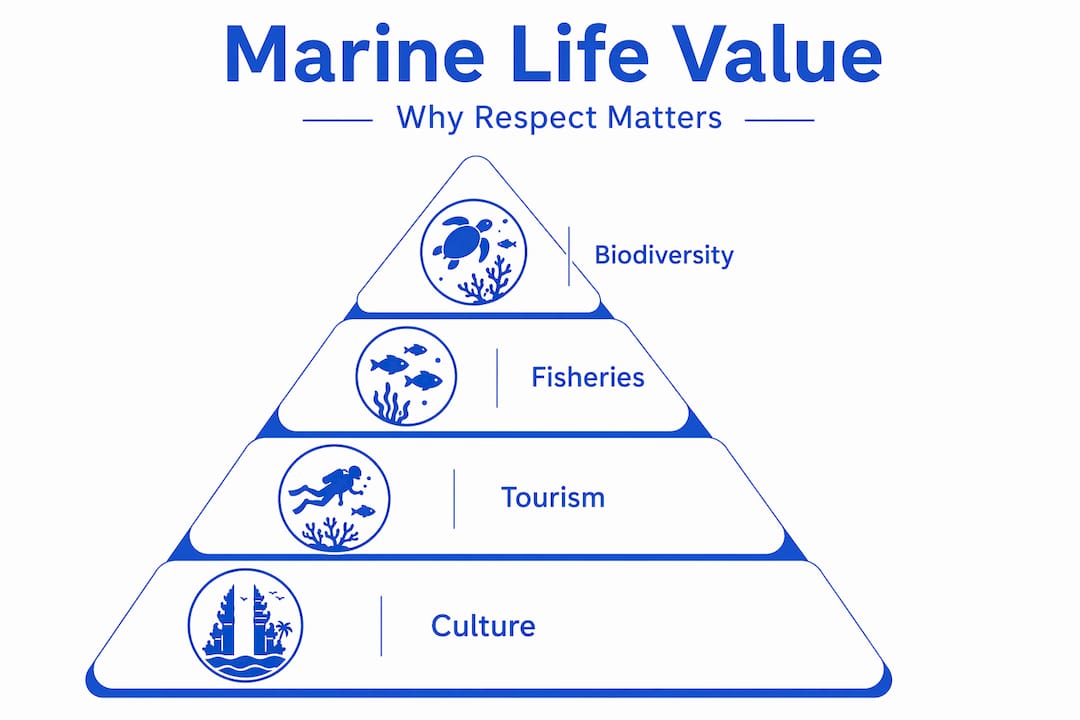
Beyond ecology, healthy marine ecosystems underpin livelihoods. Bali’s fishing communities, dive tourism industry, and coastal hotels all depend on reefs that are vibrant and diverse. When biodiversity collapses, so does the economy around it.
Threats to marine life and why respect matters
Understanding the importance of marine life makes the threats to it all the more urgent. Marine populations have dropped by nearly half since 1970 through a combination of overfishing, plastic pollution, coastal development, and climate change. The impact of fishing on marine life alone has reshaped entire reef ecosystems across Southeast Asia, including in Indonesian waters.
What surprises many divers is that their own behaviour underwater can contribute to the problem, even with the best intentions. Here are the most common human threats in a dive context:
- Physical contact with corals during entries, exits, or when a diver loses buoyancy control
- Chasing or crowding marine animals, which causes stress and drives them from feeding or breeding grounds
- Feeding wildlife, which alters natural behaviour, creates dependency, and can spread disease
- Stirring up sediment with poor fin technique, which smothers corals and disrupts filter feeders
- Collecting shells or organisms, which removes organisms from their ecological roles
NOAA’s federal guidelines specify minimum approach distances to marine mammals to prevent harassment, requiring at least 100 yards from whales and 50 yards from dolphins and seals. These rules exist precisely because disturbance has measurable consequences for animal health and reproduction.
“The ocean is not a spectacle. It is a living community. How we choose to enter it determines whether future generations inherit the same wonder we are experiencing now.”
Pro Tip: Before every dive at Amed’s reef sites, check your buoyancy in shallow water. Five minutes spent trimming your weight at the start prevents hours of unintentional damage below.
The moral and ethical case for respecting marine life
The marine conservation significance of protecting reefs is often framed in economic terms: fisheries revenue, tourism income, coastal protection. These matter, but they are not the whole picture. There is a deeper ethical argument for why we should protect ocean creatures that goes beyond what the reef is worth to us.
Coral reefs are ancient. Some reef structures have been building for thousands of years, layer by layer, through the accumulation of tiny polyp skeletons. They represent, as researchers have noted, irreplaceable genetic libraries containing compounds and organisms that science has barely begun to catalogue. Destroying them for short-term gain, or damaging them through careless diving, is not simply a loss of income. It is an irreversible erasure.
There is also the question of intergenerational justice. The reefs you dive today in Bali were shaped over millennia. They do not belong to this generation. We hold them in trust for the children who will want to dive them in 2050, 2070, and beyond. Marine conservation significance is, at its core, an ethical commitment to those people.
“Protecting marine life is not just a conservation issue. It is a moral one. We did not inherit these ecosystems to consume them — we inherited them to pass them on intact.”
Local Balinese and Indigenous communities add another layer to this responsibility. Reefs here are not only fish stocks. They are cultural landmarks, ceremonial spaces, and sources of identity that have sustained communities for generations. Disrespecting them as a visiting diver is, in a very real sense, disrespecting the people who call these waters home.
How respect improves scuba diving experiences in Bali
Here is something the most experienced divers will tell you: the best encounters with marine life happen when you are still, patient, and respectful. Chasing a sea turtle for a photograph will almost always result in a blurred shot of a retreating shell. Hovering quietly at a distance will, more often than not, result in the turtle turning back towards you out of curiosity.
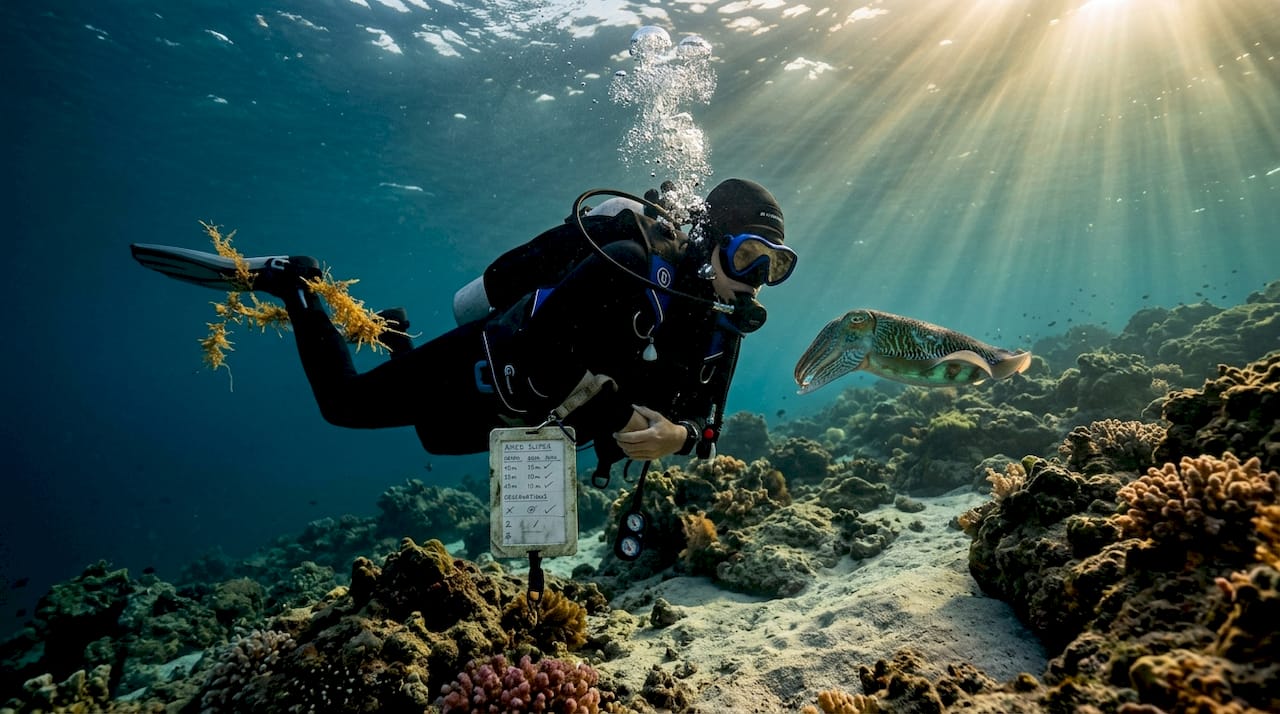
Buoyancy control is the single most important skill for protecting Bali’s reefs, and it also happens to make you a better diver. Perfect buoyancy prevents around 90% of accidental reef damage caused by fin kicks and body contact. Divers who master it move gracefully, see more, and cause less disturbance to the animals around them.
Bali’s Marine Protected Areas (MPAs) are a direct result of conservation efforts built on respectful diver and fisher behaviour. MPAs allow fish stocks to recover, creating spill-over effects that benefit both local fishers and visiting divers. A healthy MPA means more fish, more colour, more biodiversity, and a richer dive for everyone.
| Respectful behaviour | Impact on dive experience |
|---|---|
| Maintaining distance from turtles | Turtles remain calm, linger longer, and often approach divers naturally |
| Perfect buoyancy control | Vibrant coral structures remain intact for future dives |
| No feeding of fish | Natural schooling behaviour preserved, creating spectacular displays |
| Slow, unhurried movement | More marine life spotted, including shy species like frogfish and ghost pipefish |
| Following dive conservation practices | Healthy reefs sustain dive tourism and local communities long-term |
Pro Tip: Before your first dive in Bali, review your scuba diving preparation to ensure your weighting is correct. Being even slightly overweighted dramatically increases your chances of accidental reef contact, especially in the early minutes of a dive.
Key practices that consistently improve dive experiences in Bali include:
- Slowing down: Moving slowly through the water reduces fin disturbance and allows shy species to remain in view
- Scanning from a distance first: Before approaching any creature, observe it from several metres away to gauge its comfort level
- Watching behaviour, not just appearance: Understanding what a marine animal is doing makes encounters far more meaningful and shows you when it is stressed
Practical guide to respecting marine life while diving in Bali
With the why firmly understood, here is the how. These guidelines reflect international best practice and are particularly relevant to diving in Bali’s diverse reef environments.
- Keep safe distances: Maintain at least 100 yards from whales and 50 yards from dolphins, seals, and other marine mammals. For reef species like turtles and reef sharks, observe from a respectful distance and let them set the pace. NOAA’s 2026 guidelines provide a useful benchmark even in Indonesian waters.
- Never touch marine life: This includes corals, fish, turtles, and invertebrates. Contact removes protective mucus layers and transmits bacteria that cause infections and disease.
- Never feed marine animals: Feeding disrupts natural foraging behaviour, causes nutritional imbalances, and creates dangerous associations between humans and animals.
- Perfect your buoyancy before diving deeper reefs: Spend time in shallow water checking your trim, weight, and breathing before descending to sensitive coral structures.
- Report harmful behaviour: If you observe another diver feeding, touching, or harassing marine life, report it to your dive operator or the relevant local authority. Passive observation of bad dive etiquette in Bali makes us all complicit.
- Leave everything as you find it: No shell collecting, no moving of sea life for photos, no anchoring on reef structures.
| Behaviour | Acceptable | Reason |
|---|---|---|
| Photographing turtles | Yes, from distance | No contact, no pursuit |
| Touching a nudibranch | No | Removes mucus, causes stress |
| Feeding reef fish | No | Disrupts natural behaviour |
| Hovering over a coral garden | Yes, with buoyancy | No physical contact |
| Collecting a shell | No | Removes organism from ecosystem |
Pro Tip: If a fish or turtle swims towards you, stay completely still. Stillness reads as non-threatening to marine animals, and some of the most extraordinary encounters happen when you simply stop moving and let the ocean come to you.
Why many divers underestimate respect’s impact — and how to do better
After years of diving Amed’s reefs and guiding divers of all experience levels, we have noticed something consistent: the divers who cause the most unintentional damage are not the beginners. They are experienced divers who are overconfident about their impact.
A diver who has logged 100 dives often believes they have mastered the basics. But overweighting, a habit many divers never correct, causes accidental fin kicks to coral on almost every dive. The reef does not record the intention. It only records the impact.
Touching marine life is the single most common mistake we see, and it is almost always driven by excitement rather than malice. A small nudibranch seems too tiny to be harmed by a finger. A docile turtle seems unbothered by a hand on its shell. But that touch removes a protective mucus layer that the animal relies on to resist infection, and the stress response it triggers is invisible to the diver but real to the animal.
Chasing turtles for photographs is equally misunderstood. A turtle that looks calm while being followed is likely exhausted and oxygen-depleted, not relaxed. Every chase shortens the breath-hold and depletes energy needed for feeding and migration. The photograph feels like a trophy; to the turtle, it was a crisis.
What genuinely changes behaviour, in our experience, is teaching divers to redefine success underwater. The goal is not the photograph. It is the encounter. A turtle that swims towards you because you held still is a far richer experience than one you cornered against a reef. Patience and stillness are the most underrated skills in eco-friendly diving in Bali, and they are also the ones that lead to the best dives.
The divers we see grow the most are the ones who arrive curious about marine life, not just the dive itself. When you understand what you are looking at and why it matters, respectful behaviour becomes instinctive rather than a rule to follow.
Discover respectful diving with Bali Dive Cove
At Bali Dive Cove, we believe that the best diving is diving that leaves the reef exactly as you found it — or better. Our instructors bring over 16 years of experience diving Amed’s reefs, and every course and guided dive we lead includes a strong focus on marine life etiquette, buoyancy skills, and conservation awareness.
Whether you are working through your PADI dive courses or joining one of our guided Bali dive packages, you will learn how to move through the water in a way that protects what makes Bali’s reefs so extraordinary. Small groups, experienced instructors, and unhurried dives mean you have the space to develop these skills properly. Explore how our approach supports dive conservation in Bali and see what responsible diving really looks like in practice.
Frequently asked questions
Why is it important to keep distance from marine animals while diving?
Keeping a safe distance prevents stress and behavioural disruption in marine animals, helping them stay healthy and undisturbed. NOAA guidelines specify minimum distances from whales and dolphins to avoid harassment and its lasting effects on behaviour and reproduction.
How does touching coral or marine life harm them?
Touching marine life removes protective mucus that shields animals from bacteria and infection, and the resulting stress can cause animals to abandon familiar habitats. Even brief contact can have consequences that last long after the diver has surfaced.
What are some key respectful diving practices in Bali?
Maintain perfect buoyancy, keep a respectful distance from all animals, avoid feeding or touching wildlife, and follow local dive etiquette and conservation guidelines. Buoyancy control alone prevents around 90% of accidental reef damage on any given dive.
How does respecting marine life benefit scuba divers personally?
Respectful behaviour leads to healthier reefs, richer biodiversity, and more memorable encounters — the kind where marine animals approach you rather than flee. In short, the more care you bring underwater, the more extraordinary every dive becomes.
